An employer may need to make adjustments to capitalise fully on the abilities of the individual with ASD. These abilities will include: unique thinking processes, creativity, a strong work ethic, honesty, logic, conscientiousness and attention to detail.
Inclusion at work.
Jane, an imaginary employee with ASD : –
Comes to work in order to work; she does not find it easy to make small talk or socialise.
When socialising is an essential part of a job, delegate a sensitive, kind colleague to accompany Jane to any meetings in order to reduce her anxiety, and to model appropriate social behaviour. Jane will learn the desired skills through mimicry.
Feels uncomfortable contributing verbally in large groups.
Give Jane agendas in advance and allow her to write reports, rather than give oral presentations.
Experiences sensory difficulties, perhaps with noise or temperature.
Too much noise, heat or flickering light will make Jane feel ill and unable to concentrate.
If she can work in a quieter space, close to a window that provides natural light and opens for air flow, she will feel more in control of her environment.
Allow Jane to wear headphones to reduce noise or sunglasses to minimise the effect of fluorescent lighting.
Where possible, allow flexible working hours or home working.
Has a lack of social understanding that may lead to her being bullied.
Take responsibility: the employer sets the tone of the work environment. Speak positively yourself about all employees, discourage gossip, give generous praise; never ridicule. Always encourage compassionate relationships between colleagues.
Tells the truth and does not play games.
Jane may be blunt. She is not being deliberately offensive. It simply appears pointless to her not to tell the truth.
Be patient and listen to what she is saying, rather than how she is saying it.
Use humour to lighten awkward situations.
Provide a non-judgemental mentor to explain any real faux pas in a straightforward and pragmatic way.
Prefers routine and predictability.
Give precise instructions and clear guidelines, (although Jane will always work best independently and without constant scrutiny.)
Introduce any changes in routine before they happen, to give Jane time to prepare herself.
To get the best from Jane, play to her strengths rather than her weakness.
Communication. As a result of their own challenges, dyslexics understand that there are several ways to convey information, will realise they need to keep a message simple, and truly welcome and value the input of others.
Problem-solving. This is what the dyslexic does all the time. They will try to find ways around problems: how to learn effectively, how to circumnavigate their weaknesses, how to play to their strengths. They are always thinking outside the box.
Empathy. Dyslexics are sympathetic to the difficulties that others may experience. This makes them strong team players.
A grasp of the overview. Dyslexics focus on the big picture, looking past the detail and targeting the important issues.
A willingness to work. Dyslexics accept that hard work is a fact of life; appreciating the need for additional effort and the regular practice of anything that doesn’t come easily.
Resilience. Unfortunately, embarrassment and disappointment are a fact of life for many dyslexics. Dreading their turn to read aloud in class, failing every German vocab test, performing badly in exams despite putting in maximum effort. The dyslexic knows from everyday experience that it is impossible to die from embarrassment.
Patience. Dyslexics understand that nothing comes easily. They know that progress can be slow, and they will not expect instant success or reward.
A diversity of interests. Dyslexics have to find alternative ways to gain self-respect; perhaps by joining a sport club, music group, creative arts, dance or drama clubs, church or charitable associations, in order to be appreciated.
Creativity. As a result of their varied interests, alternative strengths, good visual and spatial skills, a dyslexic’s approach to challenges will be unusual and draw from a variety of ideas and sources.
Social skills. Dyslexics are socially appealing, being more interesting than individuals with conventional habits and predictable thought processes.
Many prestigious employers, for example, the government intelligence agency, GCHQ, are beginning to recruit dyslexics because of the strengths described above. It seems ironic that one government department, (Education), fails to recognise the potential of dyslexics, and yet another government department, (Intelligence), is so desperate to employ them.
Many of the problems faced by individuals with Autistic Spectrum Condition are cultural in their origin. For example, western society’s obsession with the importance of social confidence, self-promotion, networking and assertiveness.
An individual’s energy can be wasted in trying to conform. Life is about the individual being the best they can be.
A sympathetic teacher is an invaluable gift for any pupil in school. Everyone has the right to expect a positive school experience.
Many girls with ASC don’t identify with their female peers or media representations of femininity, and may have no strong sense of their gender identity.
ASC girls dress for comfort, albeit sometimes unconventionally, and many have an aversion to heavy make up or high maintenance hair styles.
Girls with ASC are usually able to socialise in small doses, but find it emotionally draining. Allow plenty of down time for enjoyable activities in order to recharge socialising batteries.
To support physical health, find activities that are personally appealing. For example, yoga or Pilates may be preferable to keep fit classes in a noisy, smelly gym. Martial arts will assist with self-regulation; an exercise bike or skipping rope will provide simple repetitive physical activity; and jogging or orienteering will offer outdoor exercise. Physical fitness supports personal happiness.
Unobtrusive everyday equipment can be used to reduce environmental excesses. Sunglasses, caps or hats in bright light; earplugs or iPods in noisy environments; and a squishy toy in the pocket for sensory comfort.
Girls on the ASC spectrum tend to be better at expressing themselves through the written word, rather than verbal interaction, and such strengths should be played to. Many ASC girls enjoy reading; and accessing a wide range of material will give valuable insights into the life and behaviour of others.
Cultivating areas of interest is the key to personal happiness and may lead to an all absorbing future career. A personal passion can be used to fight inequality, injustice and to benefit society – see Greta Thunberg, the Swedish environmentalist.
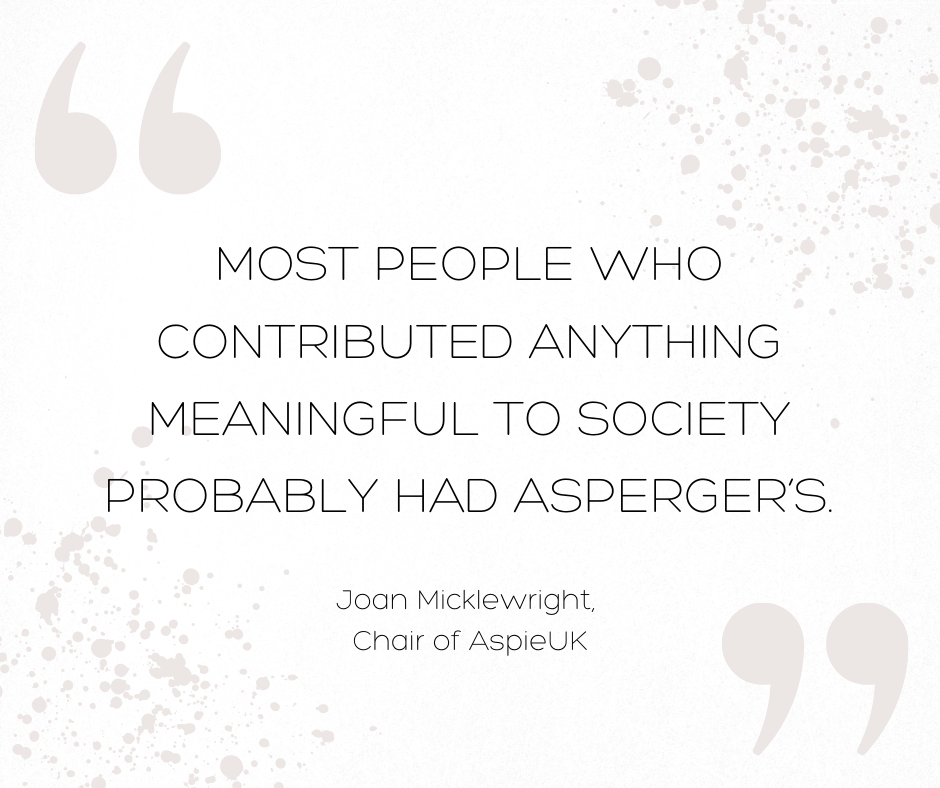
Joan Micklewright, Chair of AspieUK, talking about those with Asperger’s Syndrome.
As a result of the social norms of the time, the earliest assessments for Asperger’s Syndrome / Autism were designed with boys in mind. Girls were unlikely to be identified through these assessments, as the presentation of girls with autism differs from that of boys.
Research from Cambridge University published in March 2021, suggests that approximately one in 57 children are on the autistic spectrum, so it is important that schools are aware of the variety of ways in which children with autism behave. Many autistic girls slip through the net, as a result of being diagnosed with anxiety and depression rather than autistic traits.
One reason for this is that girls with autism tend to be better at masking than boys. Masking is the term used when a child or young person expends huge amounts of energy trying to behave in a socially accepted way. Maintaining these high levels of conventional behaviour is exhausting, and it is this constant effort to suppress their real personality and feelings in order to fit in, that causes their anxiety and depression.
Holly Smale, the bestselling author of the Geek Girls series, has recently been diagnosed with autism at the age of 39. In an article in the Sunday Times, (22.5.21), Holly describes her masking efforts.
‘It was incredibly hard work and inside I was a exhausted jittery mess, but I didn’t care as long as I passed for a regular human.’
Autistic girls will confess to feeling uncomfortable in social situations, disliking small talk, and realise that they can appear emotionally cold and somewhat odd to others. However, their passion for particular subjects of personal interest will lead to in-depth expertise, they will possess an extraordinarily accurate memory, and an ability to hyper-focus on their specific interest or area of work.
As Joan Micklewright, Chair of AspieUK says; ‘Most people who contributed anything meaningful to society probably had Asperger’s.’
In an accepting and supportive environment, girls on the autistic spectrum will blossom, and society benefit from their original and innovative female perspective.
I’m thrilled to be able to share with you an exclusive preview of a brand new Olivia Monkey story, with all-new illustrations from the wonderful Alessandra Covino.
Keep your eyes peeled for a brand new Olivia and the Proverbs book, coming soon…
Enjoy!
I’d love to hear your feedback – please do read it with your children and let me know what they think of Olivia’s latest adventure too.
Pat Guy
Olivia and the Maze
PROVERB: A person’s a person, no matter how small. (Dr Seuss.)
Olivia is a little monkey who lives with her Mummy, Daddy, older brother Pip, older sister Violet, and the family dog Biscuit, in a house near the middle of town. Olivia’s Daddy works in an office; her Mummy draws pictures for magazines; and Pip and Violet go to school.
Olivia is friends with everyone, but her best friends live in an old people’s home, the Honeypot Home for the Retired. The Honeypot Home is in the big house next door to Olivia’s house. Olivia often goes to see the old people who live in the Honeypot Home. She sits with them in the garden when it is warm, or in their big sitting room when it is chilly.
Olivia has two very best friends at the home. One is an old monkey called Boris. Olivia and Boris enjoy going into town together; having cups of tea at cafes and sampling different cakes. Boris is interested in gardening, and Olivia likes to chat to him while he tends the plants in the Honeypot Home’s garden.
Her other best friend is Blossom, an old lady monkey, whose room is on the top floor of the Home. Blossom says Boris has green fingers, which is Blossom’s little joke because Boris’s fingers are brown. Blossom’s room is full of interesting trinkets and a birdcage for Joey her budgerigar.
One Sunday afternoon Olivia and her family went to visit a big Stately Home in the countryside. Boris went with the Monkey Family because the Stately Home was surrounded by beautiful grounds, and Boris wanted to get ideas about different types of plants for the Honeypot Home’s garden.
The grounds that were opened to visitors that day included a walled garden. The walled garden was a secret garden because it had a tall red brick wall all the way around it. You went into the garden through a secret door built into the wall. Inside the secret garden were lots of different flowers and plants. There were tall hollyhocks and colourful lupins in the borders, cream and pink magnolia bushes in every corner and honeysuckle and climbing roses rambling across the walls. At one end of the walled garden were square patches of brown earth with neat green rows of vegetable plants and herbs, and in the middle of the secret garden was a pond with a statue of a fish squirting water out of its mouth.
Olivia thought that anyone who had such a beautiful secret garden would be very lucky.
After a while the Monkey family left the secret garden to walk on the paths around the Stately Home. At the back of the Home, they saw a sign pointing to ‘The Maze’. The family walked down the path towards ‘The Maze’ to see what it was like.
The Maze was a big square of lawn with lots and lots of tall hedges on it. In between the hedges were little paths. You had to go into the entrance of The Maze, and then walked along the paths between the hedges to try and find the way out. Some of the paths didn’t go anywhere and ended at a hedge, others went different ways, zig zagging around corners, so that after a while you couldn’t remember which way you were going.
There was a viewing platform high up above the back of the maze, where you could stand and watch all the people walking around in the maze.
Mr and Mrs Monkey went into the conservatory to look at the exotic orchids, and Boris took Olivia and Mr Wolf into the maze. Pip and Violet went up on to the viewing platform to watch them.
Boris and Olivia went this way and that way among the hedges. It really was very confusing and much more difficult that you’d think to try to remember which way you were going.
Suddenly Olivia looked down. Mr Wolf had been holding her hand, but now he had disappeared. Where was he? She looked behind her, but he wasn’t there. She looked along the sides of the hedges. Maybe he was caught on a branch, but she couldn’t see him anywhere.
‘I’ve lost Mr Wolf, Boris,’ she said.
‘When did you have him last?’ asked Boris.
‘When we came in the maze. Where’s he gone? He’ll be frightened.’
‘It’s alright, Olivia,’ said Boris. ‘We’ll have a look for him now. Let’s go back the way we came.’
‘But which way did we come?’ said Olivia.
She began to call, ‘Mr Wolf. Mr Wolf.’
Olivia lay down on the grassy path and looked beneath the bushy parts of the hedges either side of her. There, a few grassy paths away, she could see Mr Wolf’s woolly hat with the pink pom-pom on. Mr Wolf was lying on his back, looking up at the sky.
Olivia lay down on the grassy path and looked beneath the busy parts of the hedges either side of her.
‘I can see him. I can see him,’ she called, and began to crawl under the hedges towards Mr Wolf.
‘Wait a minute, Olivia. I can’t get down there. Come back,’ said Boris.
Bur it was too late. Olivia was off, crawling quickly under the hedges to rescue Mr Wolf.
She soon got to him and picked him up to give him a cuddle.
‘Don’t worry, I’m here,’ she told Mr Wolf. ‘It’s alright, you’re not lost. Don’t worry.’
She stood up and brushed some leaves from Mr Wolf’s jumper.
‘It’s alright, Boris, I’ve found him,’ she said.
But where was Boris? She looked around. She’d rescued Mr Wolf from being lost, but now Boris was lost.
She could hear Boris shouting, ‘Olivia, can you hear me?’
‘I’m here, Boris,’ Olivia called. ‘Come this way.’
‘Olivia dear, just listen,’ Boris called back. ‘Bend down again, look under the hedges and see if you can see my shoes: then come back under the hedges towards my shoes.’
Olivia lay down on the grassy path. A little way away she could she Boris’s boots with Boris standing in them. She tucked Mr Wolf inside her T-shirt and crawled back under the hedges towards Boris.
‘Well, thank goodness for that,’ said Boris, when Olivia emerged from under the hedge right next to him. ‘Now let’s get out of this maze before we get lost again.’
Then they heard Pip and Violet shouting form the viewing gallery. ‘Boris, where are you? We’re getting bored. Can you come out now please?’
‘We’d love to come out, but we’re lost,’ laughed Boris. ‘Can you help us?’
‘We can’t see where you are,’ shouted Violet.
‘Wait a minute,’ Boris called back.
‘Can I borrow Mr Wolf please,’ he asked Olivia. ‘He can be our guide.’
Olivia took Mr Wolf out from inside her T-shirt and gave him to Boris.
Boris carefully hooked the back of Mr Wolf’s jumper over the end of his walking stick, and then held his walking stick with Mr Wolf sitting on the end, high above his head.
Boris carefully hooked the back of Mr Wolf’s jumper over the end of his walking stick, and then held his walking stick with Mr Wolf sitting on the end, high above his head.
Olivia could hear Pip and Violet laughing.
‘Hurray. We can see Mr Wolf,’ they shouted. ‘Listen carefully, Boris. Go straight ahead to the end of the path you’re on at the moment, and then turn right.’
Mr Wolf led the way, and Boris and Olivia followed.
‘Now go left, and then right straight away,’ shouted Pip. ‘If you walk to the end of that path, you’ll seen the way out ahead of you.’ And they did and they could.
‘Well, thank goodness for that,’ said Boris as they went out of the maze.
He lifted Mr Wolf gently off the end of his walking stick.
‘That’s more than enough excitement for me for one day,’ Boris laughed, passing Mr Wolf back to Olivia.
Fussy eating and food refusal in childhood usually starts at around 20 months and continues until a child is school age. Such behaviour has evolutionary roots; protecting the prehistoric family’s young from eating potentially poisonous food as they began to move about independently and away from the watchful eye of adults.
A limited diet is quite common among primary aged children, with the situation tending to improve when the child starts secondary school. At this age it is possible to appeal to the child’s thinking brain, in addition to their increasing awareness of social norms.
Most fussy eaters’ diet consists of five to ten accepted foods, usually dry, beige coloured carbohydrates. The preferred food will be very specific: the same brand of biscuit, cereal or bread. (However, they may try different food in different contexts, for example, different types of cereal at a friend’s house.)
Be sympathetic. Think of something you would be hard pushed to eat even under the threat of torture, to get an understanding of the genuine revulsion that the child feels.
Do not hide a rejected food in one of the child’s preferred foods. These children will be alert to small changes in the appearance or texture of food, and will simply stop eating the preferred food.
Do not starve the child in the hope that they will eat. The children can appear to have no sense of appetite, preferring to go hungry rather than eat something that disgusts them.
Patience is required: give the child time. Most children require a few trial tastes before they start to eat unfamiliar foods. The fussy eater will need to try a food for a longer period of time before it is accepted. They may feel brave and agree to eat a product when out shopping, but then lose courage and refuse when the food is prepared and on the plate in front of them.
Try to reduce anxiety, both yours and theirs. The situation has nothing to do with parenting. Most fussy eaters have siblings who will consume anything and everything. You will need to have the child’s back and protect them from the comments of well-meaning family and friends. Remember that even restricted diets can supply adequate nutrition, and all you need to do is add vitamins.
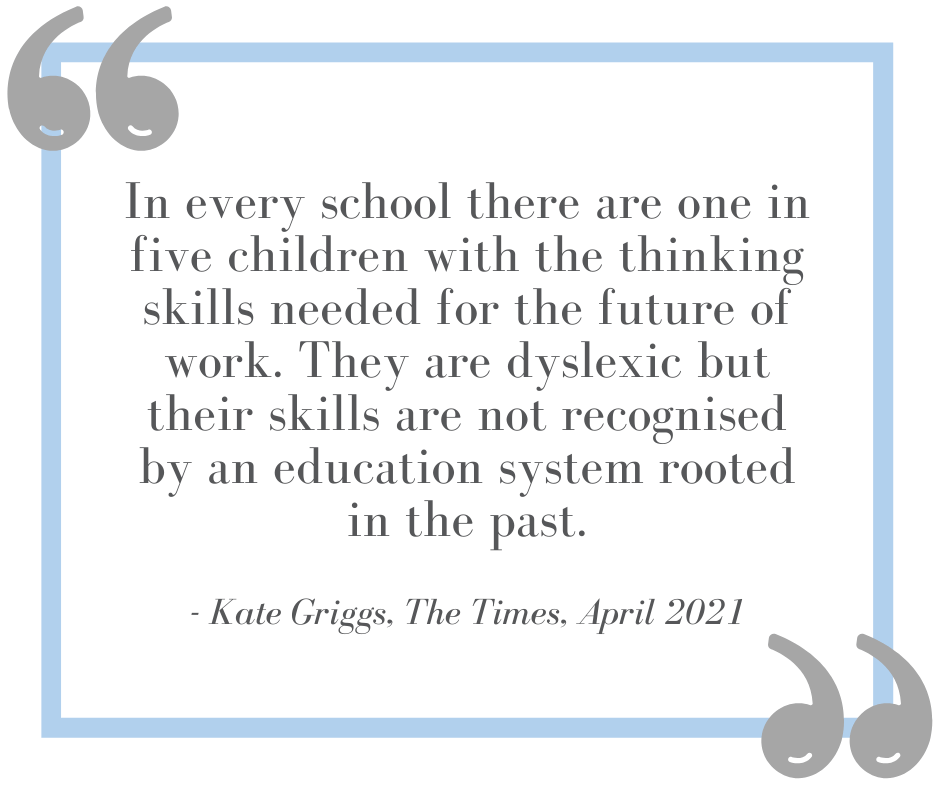
I read this article on Friday by Kate Griggs for The Times and nodded along all the way through!
She touches on so much of what I talk about in ‘Raising Confident Children’; ultimately, that change is needed in the education system to recognise the skills of the dyslexic child, and to help hone their curious, creative and laterally thinking minds.
Olivia is a little monkey who lives with her Mummy, Daddy, older brother Pip, older sister Violet, and the family dog Biscuit, in a house near the middle of town. Olivia’s Daddy works in an office; her Mummy draws pictures for magazines; and Pip and Violet go to school.
Olivia is friends with everyone, but her best friends live in an old people’s home, the Honeypot Home for the Retired. The Honeypot Home is in the big house next door to Olivia’s house. Olivia often goes to see the old people who live in the Honeypot Home. She sits with them in the garden when it is warm, or in their big sitting room when it is chilly.
Olivia has two very best friends at the home. One is an old monkey called Boris. Olivia and Boris enjoy going into town together; having cups of tea at cafes and sampling different cakes. Boris is interested in gardening, and Olivia likes to chat to him while he tends the plants in the Honeypot Home’s garden.
Her other best friend is Blossom, an old lady monkey, whose room is on the top floor of the Home. Blossom says Boris has green fingers, which is Blossom’s little joke because Boris’s fingers are brown. Blossom’s room is full of interesting trinkets and a birdcage for Joey her budgerigar.
Sports Day.
Nothing ventured, nothing gained.
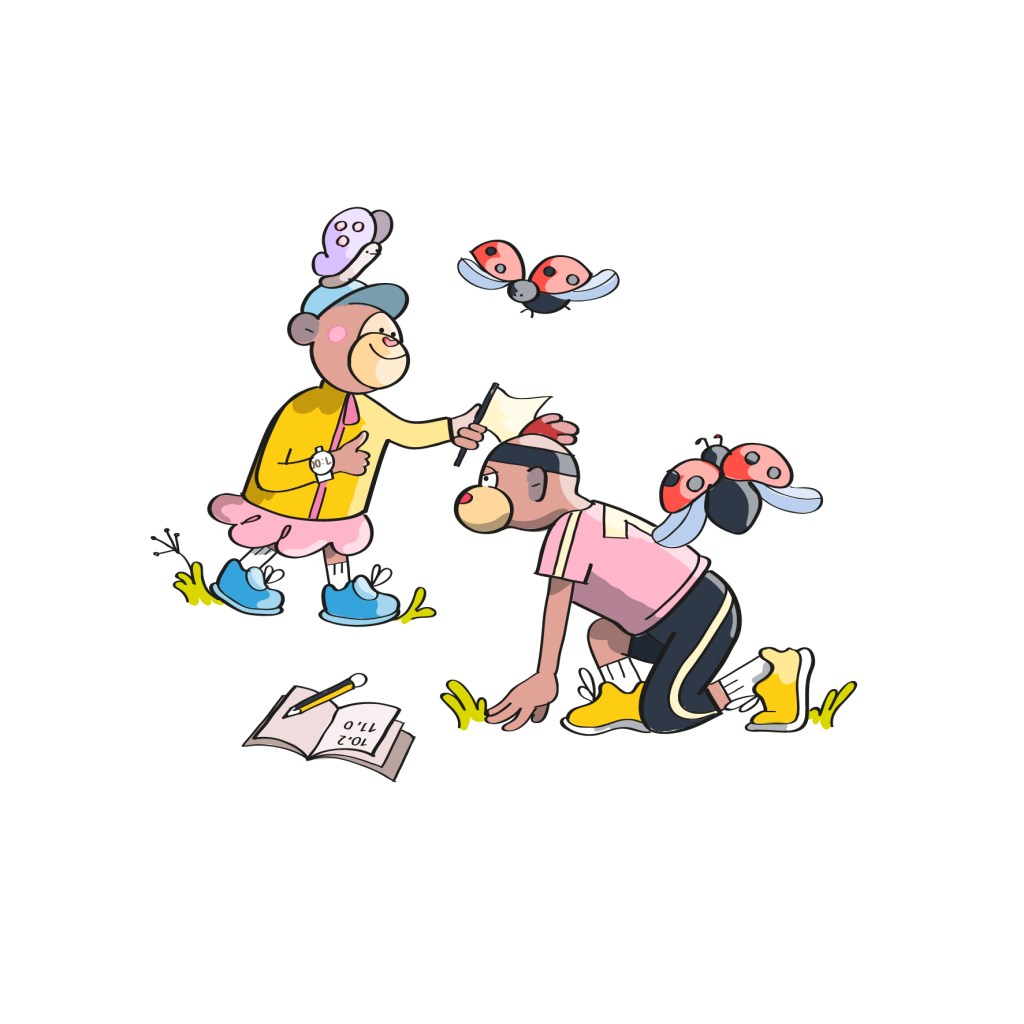
Every summer Pip’s school held a Sports Day on their playing field. Pip liked Sports Day. This year he was in the sprint race. A sprint is a race where you have to run very quickly, but not very far. Pip’s best friend, Jamie, was in the same race and Pip wanted to win. He liked Jamie, but he still wanted to win the race. Olivia was helping Pip to train for his sprint race.
Oliva had to see how long it took Pip to run from the top of the lawn, to the path at the bottom of the lawn. It wasn’t as far as the real race would be, but Pip said he needed to practise his flying starts. Jamie was a fast runner and Pip knew he would need to get ahead at the very start of the race, then hope that Jamie couldn’t catch him up.
For his flying start Pip crouched down when Olivia said, ‘On your marks.’
When Olivia said, ‘Get set,’ Pip went up on his fingertips and toes.
When she said, ‘Go,’ he sprang forward and began to run as fast as he could, arms pumping, in a straight line with his eyes focussed on the finishing tape at the end of the race.
You didn’t slow down when you reached the finish line, you ran through the tape as fast as you could, then slowed down on the other side.
Every afternoon when Pip got home from school, he and Olivia went into the garden to practise. Olivia had to press one button on Pip’s watch when he started to run and another when he finished. Then Pip wrote his time down to see if his flying starts were getting quicker.
Soon the big day came. Mummy and Olivia went to watch Pip run. Boris and Blossom came as well to cheer Pip on.
When the boys were called for their sprint race, Olivia was pleased to see that Pip was in the middle lane. Pip had told Olivia that he liked to run in the middle of everyone so he could see where the other runners were and whether or not he was ahead of them.
Pip crouched down for his flying start and when the teacher said, ‘Go,’ he flew away, ahead of all the other boys.
‘Run, Pip, run,’ shouted Boris.
‘Keep going, Pip,’ shouted Mummy and Blossom.
Olivia held her breath.
But Jamie was catching Pip up. He really was a fast runner. Would Pip’s flying start be good enough to hold Jamie off?
Pip and Jamie crossed the finish line at exactly the same time.
It was a draw.
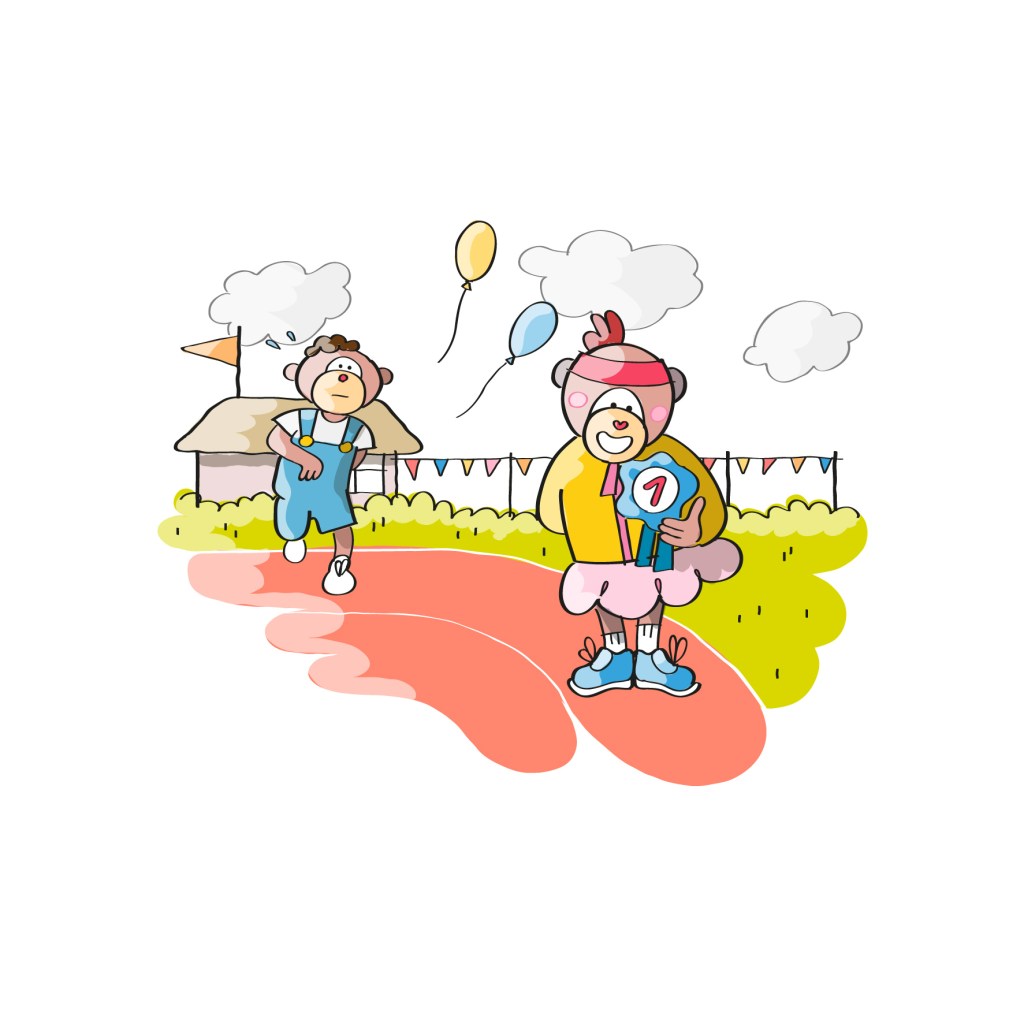
Pip and Jamie both won, and both got a yellow rosette with a number 1 in the middle. Olivia was pleased. She knew that without Pip’s flying start, Jamie probably would have won the race. Pip would be very happy, and Jamie would be a bit surprised.
Then the Headteacher made an announcement.
‘Please will any toddlers who want to join the toddler’s race, assemble at the starting line.’
‘Would you like to have a race, Olivia?’ asked Mummy.
Olivia wasn’t sure. Would she be good enough to run in a race?
‘Go on, Olivia. Have a try. I know you’re a fast runner,’ said Boris.
So Olivia and Mummy made their way to the starting line.
Out of the corner of her eye, Olivia could see Pip and Jamie looking at her and clapping.
‘Run, Olivia, run,’ they shouted.
Olivia went into the middle of the toddlers. She remembered that Pip said that was the best place to be.
The teacher said, ‘On your marks,’ and Olivia crouched down to get a flying start.
‘Get set.’ Up on her fingertips and tip toes.
‘Go.’ Off Olivia headed in a straight line down the track, eyes on the finish line, arms pumping.
She could hear Mummy, Blossom and Boris cheering, and Pip and his friends chanting, ‘O-LIV-IA. O-LIV-IA. O-LIV-IA.’
She ran on through the tape just like Pip did, then slowed down and turned round to see where the other runners were.
Everything behind Olivia was in chaos. Toddlers were running sideways across the track with their grown-ups chasing them, some had toddled off the track completely and were hiding among the spectators’ chairs, some toddlers had fallen over and were crying, others were sitting down on the grass just looking around. One Mummy picked up her toddler and ran with it towards Oliva. That toddler came second.
Mr Thomas, Pip’s teacher, was the judge. Mr Thomas shook Olivia’s hand and gave her a yellow rosette with a number 1 in the middle. The rosette was exactly the same as Pip’s and Jamie’s.
‘Well done, Pip’s little sister,’ laughed Mr Thomas. ‘I can see who you’ve been training with.’
Mummy came to collect Olivia and took her back to where Blossom and Boris were sitting. Blossom and Boris were both clapping.
‘You ran so fast,’ said Blossom, ‘I didn’t know you knew how to do a flying start.’
‘Pip showed me how.’ said Olivia. ‘Listen for an announcement, Blossom. If they have a sprint for old people, you can do a flying start too.’
‘Good grief,’ laughed Blossom. ‘Now that would be a sight to see.’
Neurodiversity is the term used to describe the variations between different individual’s mental functioning. ASD (Autistic Spectrum Disorder), dyslexia, dyspraxia and ADHD, (Attention Deficit Hyperactivity Disorder), would all be considered to be examples of neurodiversity.
The organisation of a nationwide ‘Neurodiversity Week’, signals society’s increasing acceptance of such conditions as differences rather than disorders; and an increased understanding of the advantage of neurodiversity to society.
Neurodiversity has existed since prehistoric times. The stone age woman with an attention ‘problem’ would be the individual staring out of the cave entrance who would notice the sabre tooth tiger looking in, (the rest of the tribe being focussed on lighting the fire.) The stone age man with an attention ‘disorder’ would be the hunter who spots the sleeping bison just off the main track, while the other hunters chase the woolly mammoth galloping out of their reach. The usefulness of those who think and behave in different ways has always been an advantage, and therefore not something that has been genetically pruned.
There are two sides to every coin and in school, a child may be reported as: –
‘Constantly out of seat.’ This would be undesirable in a chalk and talk lesson, but if the child’s behaviour is translated in a positive way as being energetic and lively, perfect for the Drama Studio or on the hockey pitch.
‘Deviating from what the rest of the class is doing.’ This would be seen asInappropriate in a chalk and talk Maths lesson, but independence of thought would be considered an asset in a philosophical, moral or problem solving debate.
‘Being poorly organised.’ This might lead to a detention in secondary school, but a pupil who is absorbed in their own ideas and thinks creatively, might be considered outstanding in an Art, Poetry or Design Technology class.
Neurodiversity brings strength. Different ways of thinking are an advantage when we need to devise ingenious solutions to problems.
The Second Sea Lord, Vice Admiral Nick Hine, (autistic), feels that the military needs more ‘neurodiversity’. Hine says that the only way the British military can compete with adversaries that have more advanced technology and larger funds, is through ‘thinking differently’.
Businessman Lord Sugar, (dyslexic), feels that independence of thought is essential for entrepreneurs. ‘Success comes more quickly to the entrepreneur who follows his instincts rather than the progress of his competitors.’
Climate change campaigner, Greta Thunberg attributes her intense and unrelenting focus on urging action on climate change, to her autism.
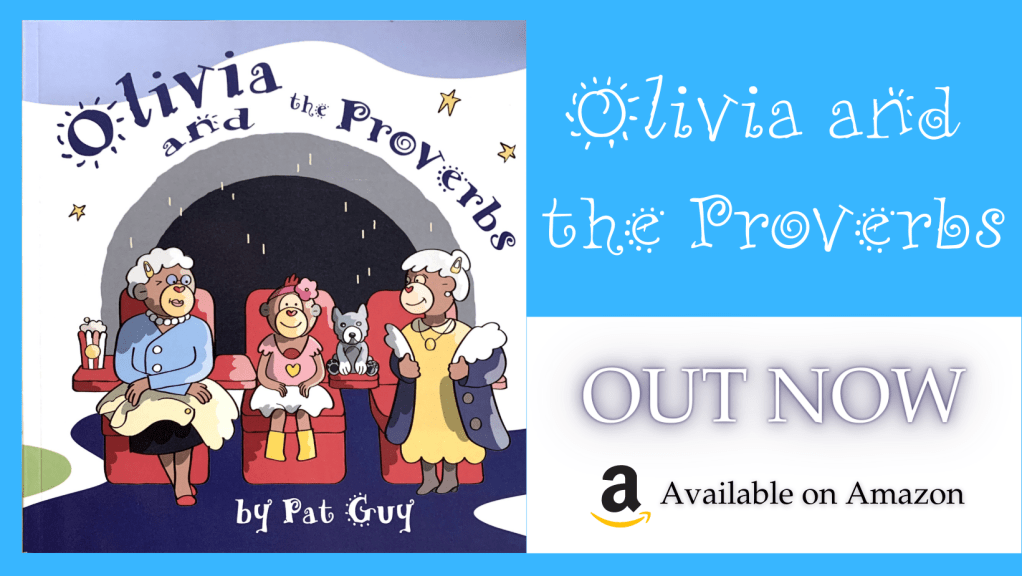
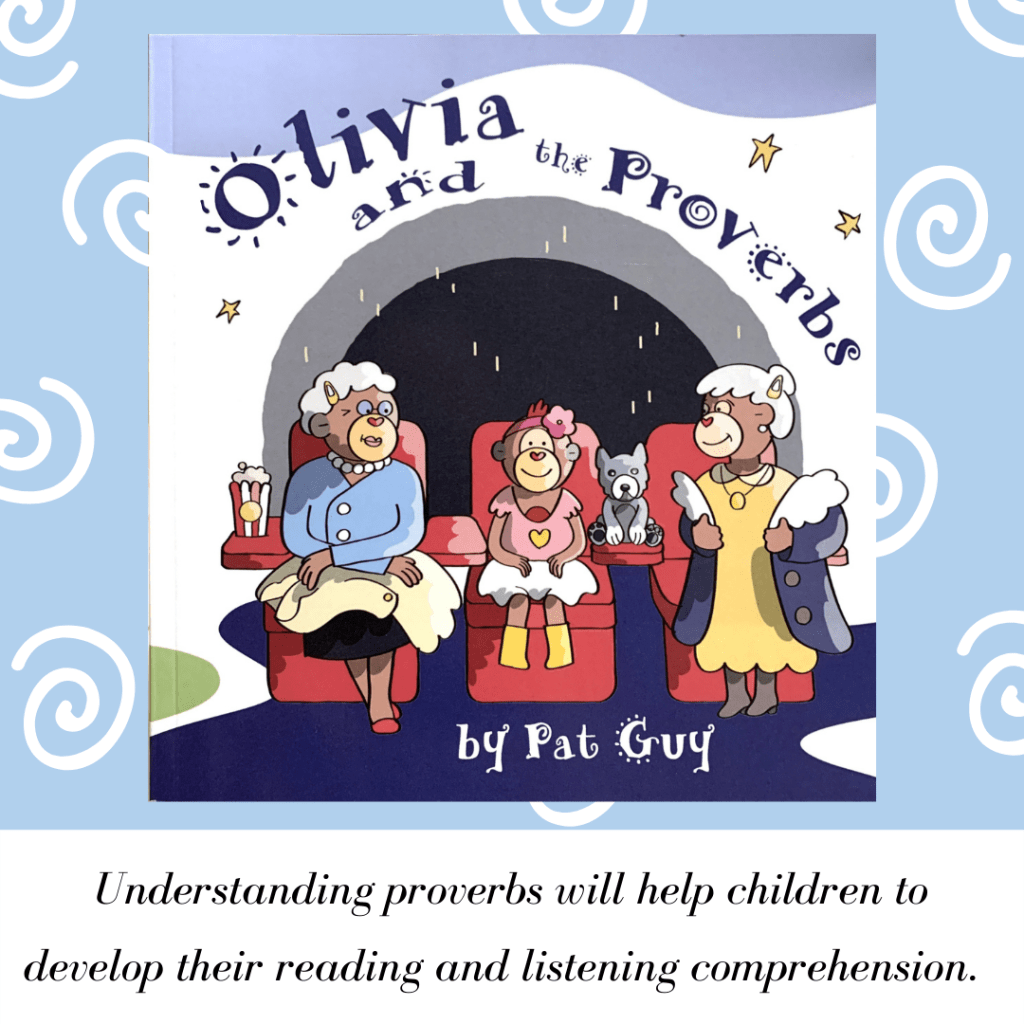
It’s my brand new book of short stories for Primary age children.
Each story is based on a well known proverb with a clear message/lesson to be learned in each tale.
Join happy-go-lucky, mishchief-maker, Olivia Monkey who lives with her family and pet dog, Biscuit, in a house near the middle of town.
The big house next door is a retirement home for elderly monkeys. Can you just imagine how much fun and monkey business goes on in there?
Olivia has so many friends at the retirement home she doesn’t have enough fingers to count them all. But two are her VERY best friends – Boris Monkey and Blossom Monkey
.Join Olivia and her very best monkey friends as they get up to all kinds of adventures and shenanigans. See what they’re doing right now! It will make you laugh out loud from start to finish!
HOW DID THE BOOK COME ABOUT?
The original stories started with my youngest daughter, Rebecca. When she was little, she had a huge collection of soft toys, mainly monkeys, who all had very different characters(!). I used to make up stories of their escapades to tell her at bedtime. I suppose Olivia is modelled to some extent on Rebecca, as being the youngest of four children is not always easy!!
I re-told the stories occasionally when I taught KS1 children. As the stories were created on the spot, I could design scenarios to fit different classroom situations as they occurred, using the stories to talk about behaviour, arguments, kindness to others, comforting or reassuring the children, and so on. Funny stories seemed a good way to approach situations sideways without appearing to target attention on any one child. Gradually I began to design specific stories for use in PHSE lessons. Then I had some EAL children in the class, plus pupils who had poor reading comprehension, and began to design the stories more for vocabulary exploration and extension.
When I came to write some stories down during lockdown last Springtime (2020), I took a slightly different angle yet again. I have seven grandchildren who all live locally and we missed their company greatly. It was difficult not to see them at weekends, pick them up from school, babysit in the evening…etc; so then the stories became more of celebration of the grandparent/grandchild relationship.
FREE RESOURCES FOR PARENTS/TEACHERS
I’m offering a set of resources/worksheets to accompany three of the stories in the book, which will soon be available for free from my website. The resource gives ideas for developing children’s vocabulary, reading comprehension, speaking and listening skills.
I hope Olivia and the Proverbs will be both an educational and enjoyable read for all.






 Pat Guy Education Specialist & Author