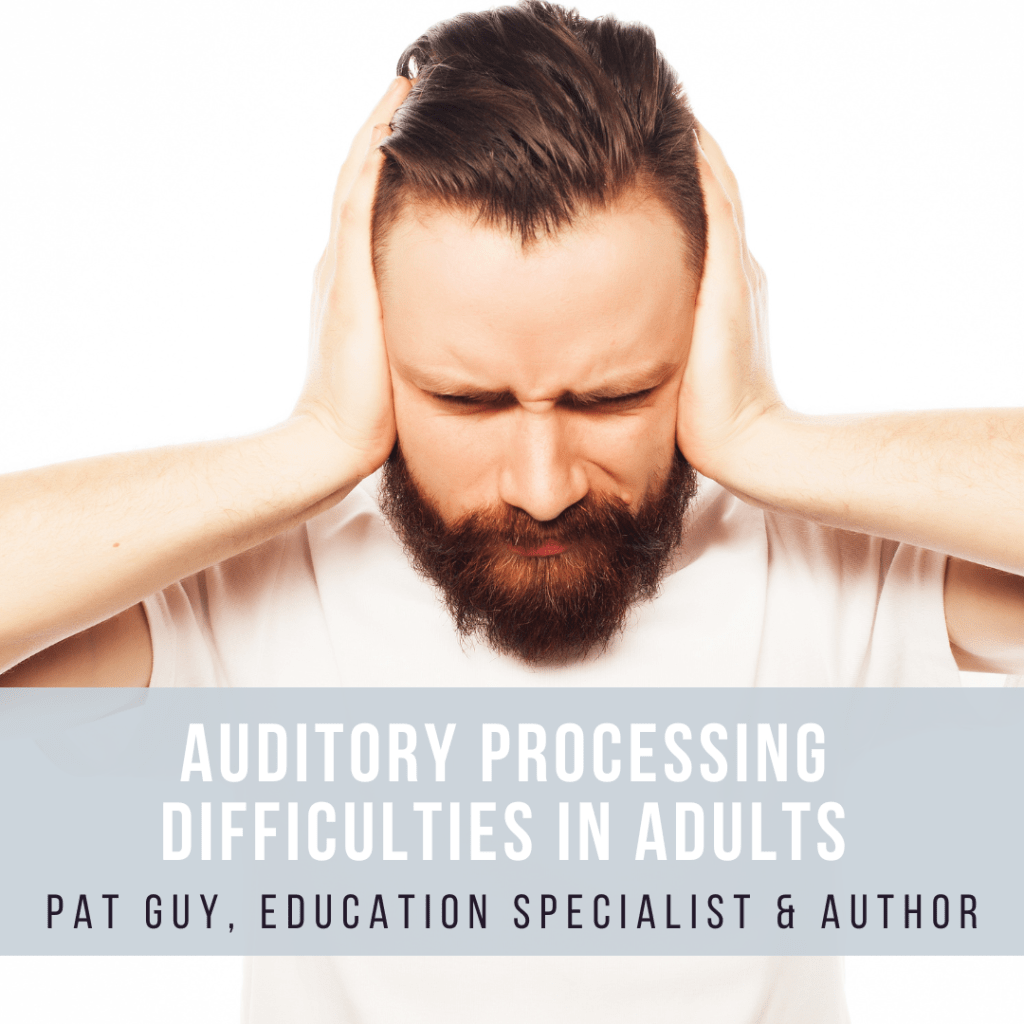
Auditory Processing Disorder (APD) in adults

APD is a disorder where an individual’s brain is unable to process sound in the usual way. Some adults will have had undiagnosed APD since childhood and established coping mechanisms for what they assume to be a personality trait.

One of the most common problems experienced by adults with APD is understanding speech in environments where there’s a lot of background noise. This has been referred to as ‘Cocktail Party Deafness’. Cocktail Party Deafness describes social situations in which it is easy to become confused by general chatter and music, whilst trying to concentrate on a one-to-one conversation.

Adults with APD will experience difficulties with: –

  • Rapid speech, unfamiliar accents, and the processing of complex spoken sentences.
  • Using the phone. During phone conversations it is necessary to ignore sounds in the immediate environment in order to focus on the person speaking at the other end of the line.
  • The nuances of speech, for example, not picking up on sarcasm or irony.
  • Following multi-step instructions. The individual may hear and remember the first instruction; but because their processing of language is slow, they miss the second instruction, but hear the third, and so fail to follow the directions properly.
  • Following discussions in an environment with poor acoustics and a lot of echo, for example, restaurants, pubs or work canteens.
  • Hypersensitivity to certain sounds: finding some noise frequencies physically painful.

How can adults manage their APD?

  • Environmental modifications such as carpeting, curtains and soft furnishings will help to absorb excess noise.
  • By minimising background noise: sitting away from fans, air conditioning units, open windows next to busy streets, or talkative colleagues.
  • By asking for help. Ask if others would mind speaking as slowly and clearly as possible, attracting the individual’s attention before speaking to them, and using body language or visuals to emphasise key points.
  • By arriving early for meetings in order to sit in the best position, away from distractions, and with a good view of the speaker’s face and any visual aids.
  • When listening, the individual should focus on the person speaking, position themselves directly in front of them, and watch their body language and facial movements carefully. Ask the speaker if they could try not to cover their mouth with their hands or speak with their back turned.
  • By writing down anything of importance: dates, addresses, appointments or phone numbers.
  • By playing to their strengths. Adults with APD often think of points they would like to make after a discussion has moved on. If being put on the spot is difficult for the individual because of the time needed to formulate their response, they may prefer to write a report, send a text or use email .

Many adults will have found their own ways over the years to cope with their APD. However, as APD is thought to have a genetic component, it is worth parents being alert to any indictors of the disorder in their children in order to help schools to identify problems early. This will enable teachers to make more accurate diagnoses, and to support the children as appropriately as possible. 
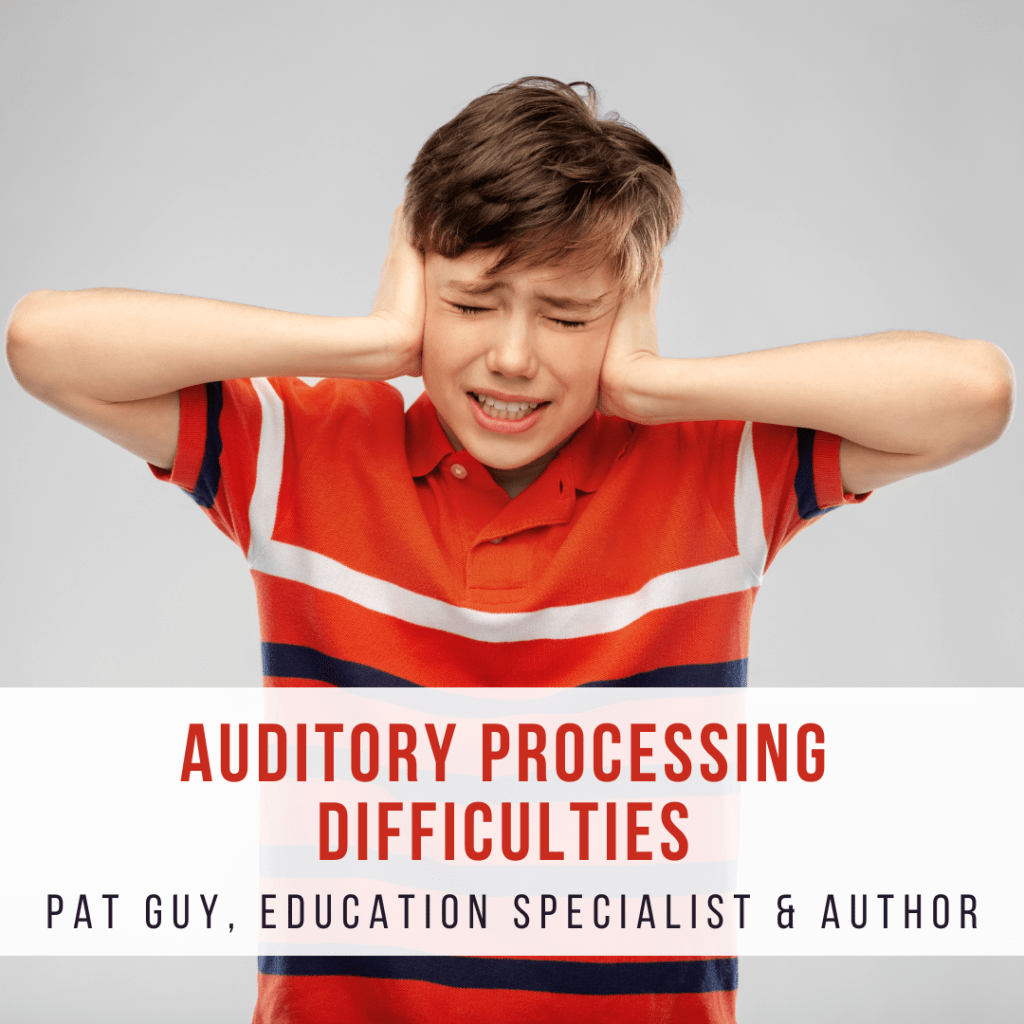
Auditory Processing Difficulties

An individual may suspect they have an Auditory Processing Disorder, (APD), when they have a difficulty with understanding and interpreting oral information. 

Although children with APD can appear to have a hearing impairment, their hearing is usually within the normal range. The individual can hear what is being said, but finds it difficult to work out what the words mean. 

It can be hard to establish whether APD is a symptom or a contributory factor of Specific Learning Difficulties such as dyslexia or attention deficit, because of the overlapping behaviours involved. 

When a child with APD cannot understand what is being said, they may ask for repetition, copy their peers, misbehave, not react, or do what they, (mistakenly), believe they’ve been asked to do. Such behaviour could be viewed by an adult as the result of the child experiencing a hearing problem, learning difficulty, having a poor memory, a weakness in attention, or simply being naughty.

Parents may suspect that the child is not hearing or listening properly at a young age, but it is normally when the child starts school that the difficulties become more obvious. 

APD is believed to affect between 3%–5% of school-aged children.

The child with APD will display some of the following behaviours: –

  • Poor listening ability, for example, confusion when following the sequence of a story or remembering the role different characters play within the story.
  • A difficulty coping with noise, and generally being more distractible in noisy environments. The child’s listening and performance will improve in quieter settings.
  • A problem with identifying sounds and words accurately, and often confusing similar sounding words, for example house and horse, muslin and Muslim, gum and gone. 
  • The child will find it hard to remember simple songs and nursery rhymes.
  • In school they will be slow to contribute to class or group discussions.
  • A difficulty following simple instructions, often misunderstanding what they are being asked to do. They will regularly request repetition of information, or closely watch and then copy the actions of other children. 
  • They will find it hard to follow rapid speech and fast-moving conversations.
  • Their poor grasp of phonics will lead to comparatively slow development of early reading. 

To help the child with APD: –

  • Reduce background noise and visual distractions. Turn off the radio or TV when speaking to the child.
  • Ask the child to repeat instructions in their own words to make sure they have understood. 
  • Be aware of the impact on the child of situations where acoustics are particularly poor. 
  • Don’t use ‘flowery’ language. Give simple directions with fewer words and instructions for the child to follow. 
  • Speak clearly and deliberately, slowing your rate of speech if necessary. Face the child and ensure they are looking at you, using their name to hold their attention. 
  • Use pictures, body language, gesture and visual demonstration to clarify information given verbally.
  • Be patient: the child will need additional time to hear, process and then respond to what is being said.

Remember – The auditory system isn’t fully developed until an individual is about 14 years old. Most children with APD will develop better listening skills over time as their auditory systems mature.

The Benefits of Boredom

‘And I remember how we’d play,

simply waste the day away.’

(Our House – Madness)

Many working parents rely on the stimulating environment of nurseries and day care centres to entertain their child while they are at work. Older school-aged children are taken from one extra-curricular activity to another after school and at weekends. Such structured and adult led input can reduce a child’s capacity to amuse themselves, encouraging a dependency on grown-ups to provide stimulus and entertainment. Perhaps there is an argument for reducing children’s reliance on adult organised activity, and letting them experience boredom. 

When a child is bored, they will: –

  1. Daydream. 

Children need time to daydream. Daydreaming encourages creativity. During free time, away from adult interference, children will play more creatively by, for example, using everyday objects for different purposes: a cardboard box becoming an animal’s shell, a goal, a house, truck, cave, shop, and so on. The more free time children have, the more creative they will become in their solutions to boredom.

2. Be prepared for life.

The adult world is often predictable and humdrum. Adults have to be able to complete routine tasks conscientiously: not everything is always exciting and entertaining. Workplaces may also demand soft skills such as: problem-solving, collaboration, creativity, imagination and cognitive flexibility. Children need enough free time to develop these skills: time to amuse themselves and bond with their peers, devising their own games without a grown-up overseeing their play. A football match does not have to have two equal sides, set positions, two goals, or be played with a football; the children can make up their own rules.

3. Develop their social skills.

A child who has nothing to do, will seek out social interaction. Children need time to play in the real world; opportunities to enjoy their surroundings, play with siblings, meet with friends, and engage in simple, everyday tasks: hanging out the washing, shopping, reading, playing in the garden. Happiness involves being grateful for simple things. Gerda Weissmann Klein, a Holocaust survivor. talked about enjoying ‘the magic of a boring evening at home.’

4. Develop personal motivation

When a child is bored, they will be forced to decide how to amuse themselves. If a child is left to pursue their own interests, they will develop their individual passions, explore different hobbies and pick up alternative pastimes. 

5. Become more independent.

Free time assists cognitive and emotional development. Children who are always occupied with adult led activity: after school care, music lessons, sporting activity, ballet, gym and chess classes, Spanish and Italian discussion groups, screens, TV, and social media, will not have the time to think or use their own brains.

6. Rest and re-charge their batteries.

When children are taken from one extracurricular activity to another, (often activities that involve little personal choice), they are likely to develop an apathy towards learning. Children need the time to rest physically and emotionally, to reflect and think about things that have happened, or that they would like to happen, to turn the TV, mobile phone or iPad off, and enjoy a bit of peace and quiet. 

7. Become less self-centred.

When children are left to their own devices, away from adult intervention and organisation, they are given a valuable message, namely, that the world does not revolve around them. 

‘Don’t underestimate the value of doing nothing, of just going along, listening to all the things you can’t hear, and not bothering.’

(Winnie the Pooh.)

The Perfectionist.

Whilst trying to do your best is always admirable, if reasonable effort turns into a need for perfection, a commendable personality trait becomes problematic. Perfectionism can lead to reduced self-esteem, unhappiness and underachievement.

The desire among children and young people for high achievement across all areas of their life: academic, sporting, appearance, popularity, etc, has escalated exponentially in recent years. One of the main reasons for this seems to be the regular testing taking place in schools. When adults placed emphasis on test results, children are constantly reminded of the value of academic success. Social media also adds to young people’s insecurity by presenting a distorted view of the lives of others, in which good looks, a perfect figure, a fabulous social life, popularity, money and success all appear to be achieved without effort. Some groups of young people seem to feel this pressure more keenly than others. High achieving girls from schools with a reputation for academic success, are among those most likely to experience the downside of perfectionism.

The perfectionist will: –

  • Become anxious quickly and worry about errors. They will take a long time to finish work or constantly re-start tasks because they aren’t going to plan.
  • Procrastinate; constantly avoiding or putting off activities because they worry that the task may be too difficult for them to complete, and they will be humiliated.
  • Become so frustrated by any mistakes they make, they abandon the whole activity.
  • Be unwilling to try anything new. The child or young person will avoid challenges and be reluctant to think creatively in case their ideas don’t work, and they’re subject to ridicule.
  • Set unrealistically high expectations of themselves, with concern about failure being out of all proportion to the task in hand.
  • Compare themselves to others; being dismissive of their own achievements.
  • Find it difficult to accept help or advice; exhibiting anger in the face of any perceived criticism.
  • Feel guilty if they aren’t constantly engaged in meaningful work.
  • Have a compulsive drive to achieve: their self-image being based on their accomplishments. 

How to help the young perfectionist: –

  • Provide unconditional affection and care: love unconnected to achievement. 
  • Listen to what the child says, empathise, then help them to view situations from more realistic perspectives.
  • Avoid comparisons with siblings or peers. 
  • Help the child to focus on the effort they are making, rather than their achievement. 
  • Encourage them to concentrate on their own performance, and disregard the performance of others. 
  • Explain the connection between mistakes and success. There are hundreds of examples of errors that led to inventions or discoveries. 

“I have not failed. I’ve just found 10,000 ways that won’t work.”

Thomas Edison – inventor and businessman.

  • Provide them with coping strategies for tackling difficult tasks by, for example, taking complex pieces of work one step at a time. 
  • Give specific praise; avoiding statements about the child being gifted or a genius.
  • Be a role model. Demonstrate how to move on and not dwell on any failures. No one is defined by the mistakes they make. 
  • Help the child or young person to understand social media. What people do and say online is a reflection of what they imagine other people want, and often very different from their reality. 

Girls’ Friendships

‘A friend is one of the nicest things you can have and one of the best things you can be.’

(Winnie the Pooh)

Children and young people’s friendships gradually increase in importance during the school years as the child’s focus moves from family towards contacts outside the home. This shift is an essential part of a child’s progress into adulthood. 

Everyone needs to belong and human beings are designed to connect with others close to them. A child will be friends with children who are at school with them, those in social groups outside school, and those who live in the same neighbourhood. Such friends will share the child’s experience, understanding how it feels to be a child of that age, at that moment in time, and in that particular context. 

Research shows that male and female friendships tend to differ: – More girls than boys will report having a best friend. Boys tend to have larger groups of casual friendships, while girls have smaller social circles, but more intimate relationships.

For many girls the transition from primary to secondary school is a period of instability. A girl’s best friends from primary school may develop new and different interests, and join alternative peer groups. While children will gradually come to realise that change happens, and personal relationships come and go, many girls find this shifting of friendships traumatic. 

It is important for girls affected by such changes to remember certain truths: –

  1. In new situations, it can be hard to find your ‘tribe’, but given time, like minded peers will appear: friends who enjoy the same activities as you and share your opinions and beliefs
  2. You don’t have to be liked by everyone. It is natural to want to belong, but try not to conform if it’s going to cost you your independence.
  3. When you like yourself, more people will like you. You will also have the confidence to steer clear of unhealthy relationships.
  4. When friendships shift, learn to be happy with your own company. Take time to do the things that you enjoy.
  5. Healthy relationships will always allow people space: if you are too possessive with friends, they may feel smothered. Sometimes friends will want to go somewhere without you, perhaps on a family outing or to a club or group they belong to outside school. 
  6. Remember that all friendships go wrong every now and then, and sometimes you are certain to be irritated by something a friend has said or done. This is a normal part of all relationships: forgive, forget and move on. 
  7. Everyone has a lot going on in their life, so it would be egotistical to imagine that your peers are constantly talking about you behind your back. 
  8. Friendship is a two-way street. If you expect friends to be there for you, you should be there for them. 
  9. You need to spend face to face time with friends to maintain relationships. It is important to do things together: go swimming, shopping, to each other’s houses or the cinema. 
  10. Good friends make you feel positive about yourself. Some girls work out their own insecurities through their friendships. On-off relationships can be exhausting, and social media make such games easy to play. Remember that manipulating others says more about the manipulator than anyone they are using so unkindly.
  11. There is a difference between being popular and being well liked. Popularity can be fickle. Girls who are popular tend to be fashionable, good looking, cool, have money and be popular with boys. Girls who are well liked are kind, fun, honest, friendly and co-operative.
  12. Friendships as portrayed in films and on TV are fictional friendships. Social media does not reflect real life. 

‘Don’t walk behind me; I may not lead. Don’t walk in front of me; I may not follow. Just walk beside me and be my friend.’ 

(Winnie the Pooh)

Young girls and body image

  1. Social media.

Remember that: –

  • Internet images are carefully posed or photoshopped. Hundreds of images will have been taken and the best two or three selected. 
  • Looking at firm and toned female bodies on social media sites does not always inspire, but rather make girls feel inadequate by promoting a body image that is unachievable for the average individual. 
  • Most women’s magazines will include ‘naughty, but nice’ recipes, followed immediately by articles about keeping fit and dieting. This is the way food companies develop business.
  • Switching off social media occasionally and enjoying real life activities in the company of others is a positive choice.
  1. Dieting.

Remember that: –

  • Healthy eating is not associated with low calories, but moderation. All things, puddings, chips, chocolate and cake included, are fine in moderation. No food is ever off limits. Healthy nutrition pans out over years, rather than days. 
  • Diets are designed with older people in mind. Adolescents need more calories than older people or young children because they are growing and developing at a rapid rate. 
  • Eating is a basic human drive. Dieting will increase your appetite and make you obsess about food to the exclusion of other more interesting activities.
  • The feeling of too many things happening all at once, may lead the individual to try to impose structure on their life. Strict dieting and fitness regimes may form part of this structure.
  • Human willpower is limited, not limitless. You may start the day deciding not to eat biscuits at break, but every time you engage your willpower in a situation, (not arguing with a friend, not answering a teacher back), your supply of willpower dwindles. Willpower is reduced by tiredness and hunger, so if you are tired or upset, you are more likely to fancy sweet and sugary food. 
  1. Self-respect.

Remember that: –

  • Even beautiful women fret about their physical appearance: – 

‘I’d like to be not so flat-chested, not to have such angular shoulders, such big feet and such a big nose.’ (Audrey Hepburn.)

Unfortunately, as a result of evolution, humans are programmed to focus on negatives rather than positives. In early human history, paying attention to things that were going wrong was a matter of life and death. Modern society has maintained this prehistoric inclination, worrying about our hairy arms, rather than focussing on our glowing skin.

  • Exercise does not have to be stressful, challenging or extreme to be beneficial. Yoga, for example, provides enjoyable exercise, developing flexibility and strength, whilst allowing time for meditation, relaxation and personal reflection. 
  • We choose our friends because they are thoughtful, funny and loyal, not because they are tall, have long hair or short legs. Be as kind to yourself as you would be to a friend.
  • Women and girls should treat each other with respect. Avoid commenting negatively on anyone’s appearance. Women come in all shapes and sizes – end of.
  1. Many things are beyond women’s control.

Remember that: –

  • What is judged as female beauty changes over time. In the 18th century, voluptuous women were admired as an ideal. There was a prevalence of eating disorders among women in the 1920s when slender, boyish figures became the trend. The 1950s saw more curvaceous women with ample breasts being viewed as attractive, before the image of the ideal female body reversed again in the late 20th century towards a slimmer look. Judgements about the perfect female body depend on many factors beyond women’s control.
  • It is normal for girls to lay down fat in puberty and adolescence.
  • Body shape and size is largely down to genetics. 
  • You can never see your body properly; even from a photo or from the image in a mirror. You will never see yourself as others see you.
  • If you lose weight, your body will retain its proportions. You will still be tall, have stocky legs or skinny arms.
  • Everyone develops at different rates. Adolescence can be particularly difficult if you are the first or last person amongst your peers to go through puberty: you may be the tallest, or the shortest, or retain a childlike figure when everyone else is developing curves. This situation will not be permanent.

‘You’re a pretty girl. What’s in your head it doesn’t matter. Brush your hair, fix your teeth. What you wear is all that matters.’

(Pretty Hurts – Beyoncé – 2013)

GENDER EQUALITY.

Statistics. 

  • According to the 2011 Census, 51% of the population of England and Wales is female and 49% male.
  • In the last set of ‘A’ Level exams taken by pupils, (2019), 25.5% of girls got A/A* grades compared to 25.4% of boys.
  • The gender split of the UK Higher Education student body is 56% female and 44% male, (March 2020). 

Women make up 55% of teaching staff in UK universities, 37% of senior leadership teams and 29% of Vice-Chancellors are female. 

  • In 2019, 53% of first year students at Oxford were female and 47% male. 

In 2019, 19% of Oxford University’s Statutory Professors, (the university’s most senior academic grade), were female and 81% male. 

In 2015 a freedom of information request revealed that amongst senior personnel at Oxford University, 13 women and 145 men were paid over £140,000 a year. 

  • In UK secondary schools, 38% of the work force are male and 62% are female, but 64% of secondary headteachers are male and 36% are female.
  • Of the 195 countries in the world, 15 have female leaders and 180 have male leaders.
  • Women over 30 years of age were given the vote in 1918. 

At the 2019 General Election, 430 male MPs and 220 female MPs were elected. A total of 6 of the 24 members of the current cabinet are women. 

In 2022, 550 males and 221 females had seats in the House of Lords. The first women took their seats in the House of Lords in 1958. 

  • In 2020, 5% of FTSE 100 CEOs were women and 95% male. Male FTSE 100 CEOs receive total remunerations averaging £5,299,609 a year, their female counterparts receive average renumeration of £4,416,455 a year: a difference of over £800,000 per annum. 

Five articles published in one newspaper, (Monday, April 10th 2022), contained information covering the following: –

  1. The Care Quality Commission’s report, (2022), into maternity services in England. The report rated 80 of 193 maternity services as inadequate and not meeting basic safety standards. A report by NHS England found that 231 women died in childbirth between 2017 and 2019, and that more than 80 of these women could have been saved had they received better care.
  2. The Home Affairs Committee’s report, ‘Investigation and Prosecution of Rape’ (2022). This report was based on data from the year September 2020 – September 2021. 63,136 rapes were reported to the police during this period, with 1,557 successful prosecutions. Successful prosecutions amounted to 1.3% of the total number of rapes reported.
  3. The UK army’s ‘Sexual Harassment Report’, (2022). This report stated that one in every 25 women serving in the armed forces had reported being raped by a colleague from the armed forces. Currently 5.6% of senior officers in the armed forces are female.
  4. Oxford University’s refusal to sign a government backed pledge against the misuse of gagging orders. These gagging orders have been used inappropriately to silence victims of sexual misconduct, or other illegal or inappropriate behaviour. 
  5. The National Gallery’s exhibition of ‘Women in our Collection’, (2022). The gallery revealed that of the 2,300 paintings they own, 25 were by female artists: equal to 1.09% of their collection. An investigation by the Guardian newspaper in 2018 revealed that female artists account for 4% of the National Gallery, Scotland’s collection and 35% of Tate Modern’s collection. 

No matter how much equality legislation is passed by parliament and how many targets set, the move towards gender equality remains painfully slow. It is up to women to be proactive and to force their way through glass ceilings in large enough numbers to make change inevitable. Those who are well served by maintaining the status quo are unlikely to be motivated to make the changes required for society to recognise women’s skills, ways of working, and to fully exploit their intelligence and abilities. 

Moving from Specific Learning Difficulties to Neurodiversity.

Neurodiversity is the term used to describe the differences in brain function and behaviour that would be regarded as normal variation within a population.

A Specific Learning Difficulty, (SpLD), refers to the difficulty a child or adult may experience with specific aspects of their learning. The most common SpLDs include: Dyslexia, Dyspraxia, Dyscalculia, Attention Deficit Disorder / Attention Deficit Hyperactivity Disorder, (ADD), along with some aspects of Autistic Spectrum Disorder, (ASD). The needs of the majority of pupils with SpLD can be met within the mainstream classroom through differentiation.

Specific Learning Difficulties are often referred to as Specific Learning Differences to emphasise that the problem is not always within the child, but linked to the demands being made of them in different contexts. 

Historically, different SpLDs were defined in comparatively narrow ways. Dyslexia being associated with literacy problems; dyspraxia with co-ordination problems; dyscalculia with numeracy difficulty; attention and hyperactivity difficulties with ADD; and sensory issues and social awkwardness with ASD. Unfortunately, these narrow definitions have created misconceptions, particularly amongst adults in school. For example: Thomas cannot be dyslexic, because he can read. Freya cannot be dyspraxic, because she’s in the hockey team. George cannot have ASD, because he can look me in the eye. Eve cannot have ADD, because she can focus when she wants to, but only on those topics she’s interested in. 

It is important to remember that any child with a SpLD is an individual, and will exhibit their own personal profile of strengths and weaknesses in the same way everyone else will do. It is not possible to put individuals into boxes.

Susanna has poor spelling and terrible handwriting, is forgetful, and dislikes noisy and crowded environments. She also loves to read, is popular with peers and teachers alike and excels at gym and dance.

Josh has limited attention, terrible time keeping, never appears to listen and has few friends amongst his peer group. He also produces beautiful poetry, is working his way quickly through his Music exams, and is Captain of the school’s debating team.

In addition to the difficulty of identifying a child as, for example, dyslexic or on the autistic spectrum, because of the overlap between different ‘conditions’, other factors play a part in a SpLD diagnosis. These factors include:

  1. Which professional assesses the child. Educational psychologists, speech and language therapists, occupational therapists and specialist teachers will all focus on their own specialist areas, and will use their own specialist tests.
  2. The child’s age at the time of assessment. The pre-school child may be assessed as having a speech and language problem and then, when they are in school, the same child will be diagnosed as dyslexic.
  3. The child’s gender. Many assessments were originally designed for boys, so male behaviour is more likely to match the diagnostic criteria. This means that girls are often overlooked.  
  4. The ethos of the child’s school. A school may be very formal, and staff may have unrealistic expectations of the pupils’ behaviour and academic performance.
  5. The child’s level of maturity. The school year starts in September and runs through to August. Those children with birthdays later in the school year, perhaps in July and August, may be developing appropriately, but inevitably be less mature than peers with birthdays in September and October.

All of these issues: the interweaving of the different SpLDs, the interaction of the child’s strengths and weakness with their SpLD, the differing levels of support and understanding they receive from the adults, limit the value of a single SpLD label, and may negate any generic support given to the child in the light of that label. 

It would be far preferable to treat each child as an individual in line with current theories of neurodiversity and to continue to advocate for the inclusion of all. 

Fidgeting

Some people are born fidgets. Fidgeting tends to be a family trait and, if parents move about a lot, their children are likely to inherit the same need for continual motion. Unfortunately, anyone who fidgets in situations where they are expected to remain still, (work meetings, concerts, plays, school lessons, church services), will appear to others as being bored, irritated or not paying attention; with those who do not experience a difficulty in keeping still, finding their peers’ constant movement annoying and distracting. 

Individuals can fidget quietly and without causing too much distraction by moving small items such as squishy, stress or koosh balls, a few smooth pebbles or coins, Play-Doh or Silly Putty about in their pockets or hand. Swivel chairs allow larger, but still discreet, body movement. Doodling, note taking or drawing can help with focus, as can seizing every opportunity for a movement break: distributing handouts, opening or closing a window, delivering messages and so on.

Alternatively, fidgeting could be elevated to a desirable trait; something to be encouraged among more sedentary members of a group. The reasons for a shift in attitude could include: – 

  1. Fidgeting helps to maintain circulatory health.

Foot tapping or leg movement while seated for a period of time will keep blood flowing around the body. Moving your legs for a minute, every four minutes, increases blood flow to the leg arteries.

2. Fidgeting helps with weight management.

Fidgeting burns calories and is considered to be nature’s way of helping us to maintain an appropriate weight. Fidgeting while sitting or standing increases the calories an individual burns, compared to when they remain sedentary: this increase can amount to between 100 to 800 calories  per day. As we only need to overeat by 100 to 200 calories a day to gain weight, the calories burnt off through fidgeting will correct any imbalance. 

3. Fidgeting supports focus and concentration.

Everyone’s concentration levels differ and we all have limits to our attention. When an individual reaches the end of their concentration span and is struggling to maintain focus, physical movement will occupy the areas of their brain distracted by random thoughts. Even small movements are enough to keep the mind from wandering without distracting from the work in hand. Fidgeting therefore, can be considered to be a self-regulation mechanism, providing just enough stimulation to bring an individual’s attention to the required level. 

4. Fidgeting will enable the individual to self-soothe.

Fidgeting can serve as a self-soothing strategy in situations where a person feels anxious. The individual can stroke their hair or face, massage their hands or neck, and swing or rock on their chair in order to self-calm. 

Perhaps a reasonable compromise to fidgeting issues would be, if the individual is not bothering anyone and their fidgeting is not impeding their functioning, just let them get on with it.

Spelling and IT

‘Words are our servants; we are not their slaves. It matters not how we spell them, it matters what we say.’

(Sally Gardner – Children’s writer and illustrator.)

A difficulty with spelling is one of the problems typically experienced by children with dyslexia. Most dyslexic children will learn to read adequately, but spelling may remain an entrenched area of difficulty.

Spelling ability depends on – 

  1. The individual’s phonological skills; that is their understanding of how sounds correspond to letters, and their ability to hear these sounds within words.
  2. The individual’s memory: most dyslexics will experience problems with some aspect of their memory.

Reading is easier than spelling because the words of a text remain in front of the reader. They will be able to examine the words and use various strategies to help with decoding, for example – What letter / sound(s) does this word begin or end with? What other words does this one look like? Are there any smaller words within this word that I recognise? Which word would make sense in this sentence?

Unfortunately, when trying to remember a spelling, the dyslexic individual is not provided with such clues, and will have to rely on their knowledge of letter / sound correspondence, combined with any recollection they have of the word’s shape and size. For example, if they depend solely on their memory of letter / sound correspondence, their spelling of the word ‘school’ will be phonetic, but inaccurate: scool, skule, scoul, skool, and so on. Alternatively. if they rely solely on their visual recall of the word’s approximate size and shape, their spelling of ‘school’ may appear bizarre: sfuuk, zofeet or szlooh. 

Reading a word could be compared to being shown a picture of the Taj Mahal and asked to identify it. ‘It looks a bit like Brighton Pavilion, but it has those pools of water in front, so it must be the Taj Mahal.’ 

Spelling the same word would be like trying to draw a picture of the Taj Mahal accurately from memory. ‘How many towers does it have? Does it have towers or arches? Where is the dome? Is there just one big dome? Is the dome higher or lower than the arches?’

Traditionally schools have offered dyslexic pupils withdrawal lessons for additional spelling intervention. In these lessons, the pupil can be taught spelling rules. An example of a spelling rule would be: ‘In the final syllable ‘sion’ the ‘si’ usually has the voiced sound /th/ as in division, invasion, etc. The syllable just before the ‘sion’ is the stressed syllable in this word and, as it is an open syllable, all of the vowels will be long except tiresome ‘i’ again.’

Such rules will be challenging for any pupil with a memory weakness, and will be quickly forgotten when the pupil starts to write an essay under timed conditions; needing to structure the essay, write legibly, and get all of their ideas down within the allotted time. 

With progress made in technology, stand-alone spelling interventions are no longer necessary for the older pupil who experiences an entrenched spelling difficulty. Nowadays is easy to circumnavigate secretarial issues such as poor presentation and weak spelling. Technology enables the individual’s work to be judged on its content rather than its appearance.

A selection of quotes about assisted technology from individuals with dyslexia: –

‘I definitely need a computer to write. It enables me to write without hesitation and it takes away the worry about spelling mistakes.’ Julian Ogiwara. Architect.

‘Technology has created a fairer platform for everyone.’ Steven Woodgate. Marketing Leader.

‘I use assisted technology all the time. I simply couldn’t do my job without it.’ James Kinross. Consultant Surgeon.

‘I used to write my books by talking into a Dictaphone, and then pay someone to type it up.’ Jamie Oliver. Chef, author.

‘I used spellcheck which negated the worst aspect of my dyslexia.’ Oliver Wright. Journalist.

‘Writing reports has become less of an obstacle with assisted technology like Dragon software and text to speech.’ Chad Choudhury. Detective Sergeant.

‘I install Grammarly on all my devices. It’s a must.’  Holly Tucker. Entrepreneur and dyslexic.