Revision

Potential revision problems and support strategies:-

  • Gaps in understanding.

Encourage the student to go to any revision or lunch time clinics at school; perhaps targeting specifically the subjects or topics they find difficult. Likewise as a parent, if the school hold talks about exams, revision or study skills, try to attend.

  • Poor study skills – not knowing how to revise.

Whilst the lead should be taken from the individual, (some students will ask for help, while others prefer to be independent), always offer support when requested. This might include helping to devise a revision timetable, testing the student on revision cards, or demonstrating how to use a whiteboard to organise themselves. 

  • Finding concentration difficult.

The student may have one preferred way of revising: admirable if the method is successful, but if not, it may be worth trialling a variety of alternative approaches. This could depend on the subject: past papers for Maths, audio books for English Literature, online interactive games for languages, revision texts for Sciences, or working with friends for Drama. Does the individual know when they work best: in the morning, evening, or at weekends? Could they revise more complex topics at that time? Using a range of revision strategies, plus regular breaks will help the student to maintain concentration.

  • Poor time keeping.

Past papers offer practice in working within exam time restraints. The individual can then calculate how long to spend jotting down the main points of an answer before starting to write, how much time to spend on different sections of the paper, and how long to allow for proof reading.

  • Procrastination.

The student will need an appropriate work area; preferably quiet, well-lit and ventilated. They will need resources to be accessible, so they don’t waste time searching for equipment. Pencils, pens, highlighters, rulers, different coloured paper, files, maths equipment, felt tips and a drink all need to be to hand. Mobiles are an excellent procrastination tool, and should be stored away out of sight.

  • Poor organisation.

A realistic revision plan is essential. Work backwards from the exams, dividing revision time between different subjects appropriately, whilst allowing extra time for difficult topics. (Past papers can be useful to help identify which topics the student finds most challenging) It is important to ensure plenty of time for guilt free relaxation, as well as for unforeseen circumstances such as illness.  

  • Low self-confidence.

When the individual gets enough sleep, exercise and follows a reasonable diet, their energy levels will be high, and it will be easier to remain motivated.  As an adult be reassuring, calm and kind. It is never too late to revise. The student will have been accessing subject classes for years, so will have retained more information than they think. Plus, there is always another chance: exams can be taken again and again, as many times as necessary.

  • A weak memory.

It is essential to interact with the information in order to remember: simply reading through notes will not be enough. Revise by doing. Revamp notes in a mind map form, record information onto a smart phone, play interactive revision games, make question and answer cards for self-testing, write out bullet point summaries from revision books, (for example, the CGP series), or devise mnemonics to remember key points. 

It is only possible to concentrate effectively for about 20 minutes, then the individual should take a short break: get a drink, walk up and down the stairs a few times, then change the curriculum subject or the revision approach. 

  • Panic. 

Encourage the individual to remain calm. Difficult exams will be difficult for everyone. What appears to be a low score may be enough for a high grade in an exam that everyone found challenging. Those individuals who remain calm and answer as best they can, will perform better than students who panic and do nothing. 

ADHD in adults

‘New hyper-fixation, Lord, I’m over-stimulated
And my mind just keeps replayin’ over and over’

(‘ADHD’ – Mae Stephens – 2024)

When school and parents feel that a child might be experiencing some form of specific learning difficulty, it is important to organise a holistic assessment: an assessment that takes information from as many sources as possible and looks at the child as a whole. It would be misguided to assume that because an individual has a diagnosis of dyspraxia, autism or dyslexia for example, they won’t also experience a degree of other Specific Learning Difficulties, such as ADHD. Individuals who have been diagnosed with a specific learning difficulty as a child, need to be aware of these issues of co-morbidity.

Key point = The presentation of ADHD in adults and children will be different. 

All individuals with ADHD will have some form of hyperactivity, but in adults this hyperactivity is likely to be internalised. Consequences of internal turmoil may include: minor car accidents, always being late or missing appointments, constantly misplacing and losing possessions, collecting parking and library fines, or feeling irritated and distressed without knowing why. 

Internal turmoil can lead to over thinking, mind wandering and excessive rumination: because of the thousand thoughts circling in the individual’s mind, they can become indecisive, procrastinate and be caught up in a circle of  low self-esteem and anxiety. ‘How does everyone else manage this without effort? Why aren’t I like that? What’s the matter with me?’

This constant stream of intrusive thoughts means that the individual will interrupt and talk over others during conversations. They will feel that if they don’t contribute as soon as a thought enters their head, they’ll forget what they were going to say. As a result they may be viewed as self-centred and rude.

Adults with entrenched ADHD are more likely to change jobs and careers;  engage enthusiastically in an interest that is dropped the following week; move house, sabotage personal relationships, and engage in risky behaviours than their neurotypical peers.

Looking back over old school reports, the individual’s ADHD symptoms may seem obvious. Teachers will have made regular comments about the need to pay attention, listen to others, concentrate in class, make more effort, improve personal organisation, and generally try harder. When the individual knows they are trying as hard as they can, but still getting it wrong, they will assume they must be stupid. When an individual receives criticism throughout their life, it is easy to see how they might over react to apparently harmless teasing or banter. Their frustration, anger, and embarrassment will lead to them being seen as overly sensitive and emotional.

Research shows 70 – 80% of people with ADHD experience anxiety or low mood during their life time. If they seek help, they may be given medication and treatment that is not designed to alleviate the cause of their difficulty. Professionals will look at the presenting symptoms: the anxiety, restlessness, depression, insomnia, binge eating, or anger management issues, and treat those issues rather than the underlying ADHD. 

If the individual is diagnosed with ADHD and given the appropriate medication and support, their problems may not be fixed immediately. They may have to overcome lingering resentment about the delay in an accurate diagnosis. They may feel angry about being criticised and made fun of when they were younger; frustrated that they were accused of not caring, when they actually did care a lot. They did keep trying to change, to concentrate more, to take care, to be thoughtful, work hard and really make an effort, but still didn’t manage it. They will have to learn new habits and attitudes for the new them, and this will take time.

A is for attention that I try to take the lead
And the D is for the deficit of functionality
Then the H is hyperactive, which is absolutely me
And (D) disorder is the wrong term, it’s just my normality’

(‘ADHD’ – Mae Stephens – 2024)

Specific Learning Difficulties and the challenges of co-morbidity

Most SpLDs: dyslexia, attention deficit, dyspraxia, language problems and some aspects of autism are co-morbid. Co-morbidity refers to different conditions that co-exist. Although a child’s initial assessment may show Attention Deficit Disorder to be their main area of need, they are certain to experience degrees of dyslexia, dyspraxia, autistic traits, dyscalculia or language difficulties. 

These additional SpLDs may not be acknowledged in the initial assessment because co-morbidity makes the identification of the root of a problem complicated. A primary aged child may be diagnosed with dyslexia but, in addition to their obvious difficulties with literacy, they experience problems with: following instructions, concentration, grasping overviews of texts, poor motor skills and problems with number. These challenges could be due to the child’s dyslexia or alternatively, as a result of their ADHD, dyspraxia, dyscalculia or language problems. The child may not have reached the threshold for a positive diagnosis of those specific learning difficulties when assessed and, as literacy problems are the child’s immediate difficulty, dyslexia will seem to be the most pragmatic label that can be given.

Dyspraxia, speech and language disorder or dyslexia are observed in 50% of individuals with ADHD, and in nearly all of the children diagnosed with Asperger’s Syndrome.

While it is usual for one SpLD to be dominant at a certain stage of a child’s life, it is also usual for other co-morbid conditions to be more challenging at other times. A pre-school child may have speech and language issues; the same child will experience literacy / dyslexic type difficulties in primary school; and then attentional weaknesses in secondary school. Sometimes, as a result of unassessed needs, the young person may be viewed as experiencing social, emotional and behavioural problems by the time they are a teenager. 

The individual’s problems will continue into adult life, although the focus and impact of the difficulty will change. For example in the case of ADHD, the outward display of attentional problems common in childhood, will be replaced in an adult by internal turmoil. The individual will complain of stress, panic attacks and exhaustion; they may be diagnosed with anxiety, depression or bi-polar disorder. Other adults may be treated for insomnia, or develop eating disorders related to their impulsive behaviour. Pensioners may be assumed to be experiencing Alzheimer’s, and referred to memory clinics, although a poor memory and slow processing are common amongst individuals with SpLDs. Treatment for anxiety, depression, sleeping disorders, eating disorders and dementia will be ineffective because the underlying problem is not being treated.

It is vital that the impact of co-morbid SpLDs such as ADHD on adults is understood by medical professionals and the person themselves. The ideal initial assessment for an individual would involve a multidisciplinary team of professionals providing a comprehensive overview of all the person’s primary and co-morbid needs. Without such overarching, holistic assessments, there is a danger that many individuals will experience chronic unhappiness throughout their adult life, as a direct result of unrecognised difficulties and misdirected treatment and support. 

ADHD – Hyperfocus

ADHD is usually viewed as being a difficulty of concentration, attention and focus. However, rather than an individual with ADHD lacking the skills of attention, the difficulty is more one of an inability to regulate their attention. 

The concentration of individuals with ADHD will improve if a piece of work interests them; if it is novel, has a tight deadline and combines some degree of competition and challenge. When engaged in such an activity, the individual will focus exceptionally well. This high level of concentration is known as hyper-focusing. When someone is hyper-focusing, they become completely absorbed in a task, paying little attention to anything else that is going on around them. 

Many scientists, writers, sportsmen and women, musicians and artists have successful careers because of this ability to hyperfocus. Some of the greatest discoveries and inventions result from a person concentrating on an activity for hour after hour, long after others have given up. The task will not seem like work because the individual is so involved in it.

When a child with ADHD is able to hyper-focus on a favourite activity, (Lego, tennis, chess, playing the drums, gymnastics, gaming, etc), they will develop their skills in that area, which in turn will boost their self-esteem. Hyper-focusing on a favourite hobby is the perfect way to increase a child’s confidence, develop friendships, raise their profile among their peers, in addition to giving opportunities for relaxation and pleasure. 

For a parent or teacher of a child with ADHD, their particular area of interest will be the perfect motivator. For example, a child may find the process of reading tedious, but will enjoy reading texts that centre around, for example: golf, Formula One, a specific band, collectable figures, Greek myths or a favourite TV programme. 

One of the best examples of using hyperfocus to advantage is in sport: –

Individuals with ADHD can excel at sport because of their seemingly endless amounts of energy. At the same time, sport will benefit them by providing structure, social interaction, physical exercise, fun, support with emotional regulation and a socially acceptable way to burn off excessive energy.

When the individual with ADHD is able to bring the ability to hyperfocus to a sport, additional advantages will come into play. They will be able to keep practising long after other members of their team have finished, and focus on refining small points of technique vital for improvement. To be ‘in the moment’, totally focussed on the game, ignoring the distraction of the crowd or needling from the opposition.

Examples of well-known sports men and women with ADHD include: Michael Phelps, (swimmer). Michael is the most decorated Olympian of all time having won a total of 28 medals. Simone Bile, the most decorated American gymnast in history, and Nicola Adams. In May 2016 Nicola was the reigning flyweight Olympic, World and European Games female boxing champion. 

‘I think about what I’m doing right now; just being lost in the moment.’ Ryan Hall, (Marathon runner)

‘Maintaining focus is all important.’ Jack Nicklaus, (Golfer)

Preparation is everything and focus is the key.’ Eric Cantona, (Footballer)

Teenage Girls – Dealing with Anger

It is quite normal for teenagers to feel angry with everything and everyone. During the teenage years. strong emotions are due to a combination of hormonal changes and the developmental stage of the brain. While annoying people will still exist when teenagers reach adulthood, their brains will be more mature, and they’ll better able to regulate their emotions. 

Stepping away from situations, whilst a good solution, isn’t always an option if the annoying person happens to be your form teacher, a sibling or classmate. As a teenager, you cannot reduce the irritability rating of others, so you will have to change how you deal with the situation or person.

Strategies that might help would include: –

  1. Distracting yourself.
  • Count ceiling tiles, count backwards from 100, or say the alphabet in reverse. The task being difficult enough to make you concentrate, and put some mental space between you and the aggravating situation. 
  • Repeat a mantra silently to yourself: ‘This is irrelevant.’ ‘Who cares.’ ‘Bothered.’ ‘This isn’t helpful.’ 
  • Find a new and engaging hobby. Perhaps something creative: cooking, designing houses or new fashions, knitting, sketching, drama or dance. Anything you can enjoy and get absorbed in that will stop you from ruminating about situations.
  • Use the Arts. Write poetry to describe your feelings and then illustrate the poems. Take up art and paint or draw your emotions. Write short stories about the bad guys and how they get their come-uppance.

2. Using self-calming techniques.

  • Calm your breathing. Breathe in slowly through your nose and out through your mouth, (smelling a flower, then blowing up a balloon) 
  • Do something to raise your spirits. Apply a nice smelling hand lotion, or look at a photo of your pet or a special place you like to visit.

3. Participating in activities you enjoy to raise your general mood.

  • Think about what you enjoy most and do more of it: reading, drawing, sport, listening to music or watching a feel-good film. 
  • Plan treats for yourself for the evening or the weekend.
  • Exercise will help to you to relax and improve the quality of your sleep. Go for a walk or a jog: the fresh air will calm you down. After you’ve exercised, your mind will be clearer, you’ll be calmer and more able to think of solutions to a problem. Try boxing or skipping to work off excess negative energy and tire you out. Martial Arts are good for developing emotional control and learning to keep calm, as well as providing a good physical work out. 
  • Mindfulness and yoga are good for relaxation, de-stressing and keeping calm.

4. Developing positive friendships.

  • Find your ‘tribe’: people who are like you, share your interests and who you enjoy spending time with. Make friends with individuals who are ‘radiators’ not ‘drains.’ Radiators will reflect warmth, kindness and fun, while drains are negative, moan and sap your energy. 
  • How much do irritating people really matter? Will you still be friends with them after you’ve left school? Write letters to the people who annoy you most, explaining why they get on your nerves …… (but don’t give them the letters!!)
  • Think what advice you would give your BFF if she was feeling angry, then give that advice to yourself.

5. Thinking about the biology of the situation.

  • Are your emotions linked to your hormones?  It may be that feelings of anger are linked to your menstrual cycle. Levels of dopamine, (known as the happy hormone because of the way it affects a person’s mood), rise and fall during the menstrual cycle. Knowledge about the body makes changing emotions easier to understand and deal with.
  • Seasonal Affective Disorder, (SAD), can make people feel unhappy in winter. As a result of the shorter days, the individual doesn’t get enough sunlight to boost their mood. Make sure you get outside during the day, and try to sit near a window as often as possible. Some people use a ‘light box’. This is a special lamp for use in the home that mimics sunlight. 
  • Try to work out when and why you get cross. Are you tired or hungry, disappointed, embarrassed, frustrated? Could you help yourself by, for example, getting more sleep? Having a better diet? Should you take vitamin tablets to cover gaps in your diet? Would iron tablets compensate for heavy periods?
  • When you get cross about something, check that you have understood the situation correctly and are not imagining that it’s worse than it is. There’s a support programme some people find useful called CBT, (Cognitive Behavioural Therapy). CBT programmes aim to change your thinking from negative to positive. You’ll find CBT workbooks in most stationery / book shops.

6. Directing your anger in a useful direction.

  • Use your anger to make change. Focus outside yourself on the problems experienced by others. If you feel something is unfair at school, start a petition, write a letter to the Head explaining why it’s unfair, what should be done and by whom. Direct your anger towards things that need to improve: litter in the playground, recycling, bullying, unfair detentions, uniform rules, supporting the under-dog generally. This may also put your own issues into perspective.

Anger can be used for the good when directed towards injustice, inequality, discrimination and prejudice. It is when anger is internalised or use inappropriately, that it becomes a destructive force.

Practical solutions for the challenges of ADHD. Challenge 2 = Time management

ADHD is a biological disorder involving an impairment in executive functioning. This impairment affects an individual’s skills of, for example: organisation, self-regulation, memory, motivation and time-management.

Strategies that might assist the individual with ADHD to manage their time: –

  • Make sure there is a visible clock in each room. Always wear a wristwatch.
  • Establish a morning routine. To save time, lay out what you plan to wear the next day, the evening before. Post notes in the bathroom, bedroom and kitchen with the time allowed for showering, dressing and eating breakfast.
  • Resist the temptation to make one last phone call, get something out of the fridge for dinner or clean the bath before leaving home
  • Keep your lights and TV on a timer to shut down automatically, and remind you it is bedtime.
  • Keep to a set bedtime to ensure tasks have to be completed early in the evening. 
  • Try to estimate how long activities will take. Regular practice in guessing the time it takes to do things, may lead to an improvement in an individual’s overall time management.
  • Listening to music is known to help individuals with ADHD concentrate, but has the added benefit of improving their ability to perceive the passage of time. Rather than setting a timer or alarm for an hour’s work, put on a playlist that lasts for an hour. 
  • Avoid taking on too much and delegate tasks to others. It is easy to overestimate the number of tasks that can be completed within a certain period of time. 
  • Set a timer or watch alarm to remind you when you should finish a task. Program a phone alarm to vibrate every 15 minutes in order to check you are still working on a specific task and haven’t been distracted. If random ideas or thoughts occur to you as you work, note them down, but then carry on working. 
  • Tell friends or colleagues of the time you have allowed for tasks, and ask them to check that you are keeping to your timetable.
  • Taking short breaks as you work may seem like a waste of time, but will refresh your brain and help you to function more effectively. 
  • Allow yourself small rewards when work is completed or focus maintained. 
  • Whenever you have to be somewhere at a specific time, add in travel time and unforeseen circumstances time allowing for late trains or buses, traffic jams or car park queues. 
  • Some people don’t like to arrive to appointments early because of the irritation felt when killing time. If early, spare time could used productively: tidying a handbag, throwing away old receipts and tickets, rewriting to-do lists or answering text messages.
  • Create a to-do list. Colour code work to be completed according to urgency. Choose four or five of those tasks to do that day, and remove them from the list once completed to give a sense of progress. Some individuals with ADHD prefer to compile to-do lists the night before, so they don’t worry about the tasks whilst trying to get to sleep. 
  • Most individuals with ADHD work well to deadlines. Deadlines create a sense of urgency, so divide up longer pieces of work to create several deadlines. 
  • Think about the times when you know you work well. Is there a particular time of day, work area or kind of task that you manage well? Is it possible to use that knowledge to manage your time more effectively?

Practical solutions for the challenges of ADHD

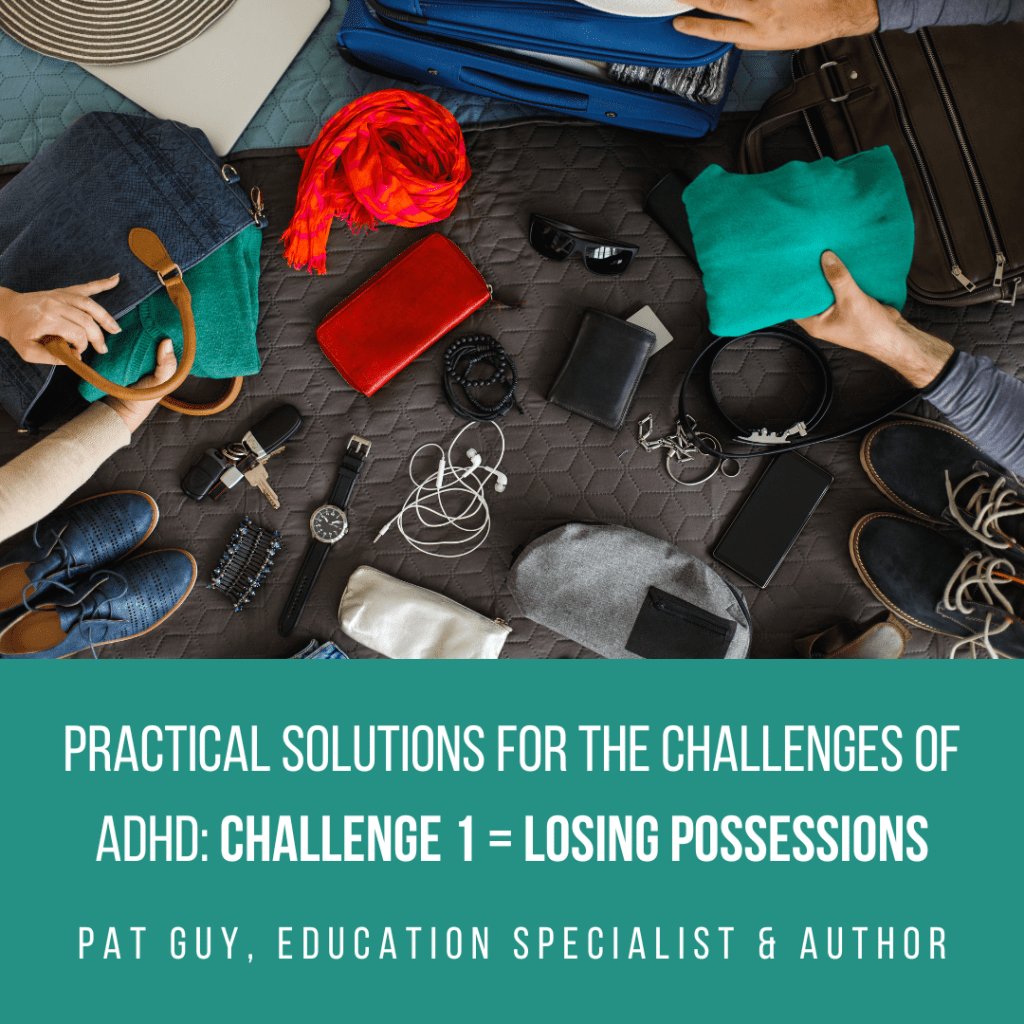
Challenge 1 = Losing possessions

ADHD is a biological disorder involving an impairment in executive functioning. This impairment affects an individual’s skills of, for example: organisation, planning, concentration, time-management, self-regulation, memory and motivation.

Consistently misplacing possessions is one result of poor executive functioning. The individual with ADHD will have poor concentration, they may have been distracted when they put the item down, and a weak memory will leave them unable to automatically recall where they left it. The lost item may be expensive, of sentimental value or essential for the individual’s work: this will make no difference to the individual’s ability to keep it safe. 

10 strategies that might assist: –

  1. Individuals with ADHD tend to only see what is in their line of vision. It is very much a question of out of sight, out of mind, so it will help if important objects are stored at eye level or within clear sight. Use brightly coloured cases for glasses and phones, put reflective tape on the TV remote and attach keys to a large, unusual key chain to increase their visibility. Group the same items together. All medicines in the same cabinet. All house keys in a pot or on a hook by the front door. All make up in a transparent zipper case to keep it separate from other items in your handbag. 

2. If you have responsibility for keys at work, keep them on a lanyard around your neck or on a keyring clipped to your belt: when items are attached to your body, you’ll be unable to misplace.

3. Have at least two sets of house keys. Leave spares for emergencies with a family member or friend. 

4. Keep to routines. Always park your car in the same part of the car park, for example, first row on the third floor, as close as possible to the lift. Tying a piece of coloured ribbon to the car’s antenna may make it easier to spot from a distance.

5. Store things in the place they are likely to be used, for example, sunglasses in the glove box of the car, stationery in your desk, tools in a tool box.

6. Buy the same make, style and colour of socks and gloves, then when you lose one, you will still be able to make a pair.

7. Create your own structure. Always return your house key to your purse or wallet after use. Always return your car keys to the front pocket of your handbag. If you routinely put objects in the same place, hopefully you will do that automatically even when distracted, or at least you’ll know where to start looking for them.

8. Think about when and where your usual errors occur and make a determined effort to pay close attention in those situations. For example, if you have a tendency to forget your keys in the morning, triple-check that you have them with you. As you get ready for work, check to ensure that you still have the keys. Check again immediately before leaving, then again after you’ve put on your coat.

9. For expensive possessions, tracking devices can be useful, for example, AirTags or Tile. When you misplace an object, the tracker will play sounds via an app to help you to locate it. Apps such as ‘Remember the milk’ or ‘Todoist’ are helpful as supportive memory aids.

10. Ask sympathetic neurotypical friends for help. Before you leave work or a meeting, they can check you have picked up all of your belongings, ask if you have your keys or whether you have put your glasses in your bag. 

Optimism

‘No matter where you go, there you are.’

(Confucious)

‘If only I was slimmer, didn’t wear glasses, was intelligent, more popular. If only I was sporty, funny, had a boy / girlfriend. It’s all right for people who are rich, live in the South, have a good job, go to a private school.’

If such wishes could be granted, would the people making them be any happier? If they had cosmetic surgery to enhance their cheekbones, would their life change for the better or would they feel their chin now required improvement? If they got a new job, would their job satisfaction improve dramatically? If they began to wear contact lenses rather than glasses, would they feel more confident and outgoing? Is the grass always greener? Does change always bring the contentment that is hoped for?

No matter what the wish and whether it is granted or not, the one person who will share the new experience with the individual is themself. Some people only seem to see the negatives in situations, so that being in a new job or having a new appearance may not bring the satisfaction they were hoping for. Perhaps before making changes to our environment or appearance, we need to think realistically about how such a change will improve our life experience. 

A staged approach to such thinking is useful, with the exercise broken down into steps. Firstly, examining our patterns of thinking, secondly, looking at exactly why we think in the way we do, and finally, how to break any negative thinking habits.

  1. Being aware of negative thinking patterns.

Are we aware of the negative patterns of thought processes we have created for ourselves? If we realise that we always assume there is a cloud to every silver lining, we may be more able to make changes for the better. 

2. Thinking about why we do this.

There are several reasons for developing pessimistic thought processes, for example, we may have picked up other people’s, often our parents’, attitudes. Some individuals might have experienced hardship or trauma, and while a cautious approach to life to avoid disappointment or embarrassment might have been useful in the past, it may not be appropriate now.

3. Ways to break the habit.

  • Surround yourself with people who have a positive attitude to life. Mix with radiators, people who exude warmth and positivity, rather than drains, people who sap your energy and optimism. 
  • Be aware of when you are overly self-critical. Would you offer such criticism to a friend, or would you offer compassion and support? Be as kind towards yourself as you would to others. 
  • Be aware of the dangers of perfectionism. No one is perfect; it is an impossible target. Our work, appearance, confidence, social ability, all only need to be good enough.
  • Be self-disciplined. If you find yourself thinking in a negative way, distract or busy yourself. Engage in an activity or hobby that you enjoy and can become absorbed in. 
  • Try to avoid seeing things in black and white: there is a lot of ground in between. Try to focus on the reality, rather than your personal perception of a situation.
  • Take a small step approach to becoming more positive. Target one area for improvement at a time, and put your energy into increasing your optimism in that area. 
  • Seek humour in everyday events and try to take yourself less seriously.
  • Maintain good physical health to maximise your energy, help you to feel optimistic and able to make changes: exercise, follow a sensible diet and make sure you get enough sleep. 

ADHD – The Female Factor

In 2022, a study that looked at women’s experience within the UK healthcare system, found that 44% of respondents felt the concerns they discussed with medical professionals were not taken seriously. 

Several factors contribute towards misconceptions around women’s health problems. One of the major hurdles being that historically, diagnostic criteria and research into medical conditions focused solely on men, without an appreciation that women do not always experience medical conditions in the same way. This is only just beginning to be rectified. In the case of Attention Deficit and Hyperactivity Disorder, (ADHD), the National Institute for Heath and Care Excellence guidelines were amended just five years ago in 2018, in order to recognise the different ways in which women and men with ADHD present. 

Males are believed to be more likely to experience the hyperactive/impulsive traits of ADHD: excessively restless, disruptive, loud, impulsive, self-centred, impatient, drawn to high-risk behaviour, with their emotional dysregulation manifesting itself as an anger issue. Such behaviours make a diagnosis of ADHD more likely during childhood.

Females tend to exhibit the inattentive aspects of ADHD: problems with focus, organisation, attention and memory. 

Some of the characteristics of attention deficit, for example, excessive daydreaming, being seen as shy, withdrawn, emotional or ‘dizzy’, are often perceived to be female personality traits, rather than potential ADHD symptoms. 

Society expects women to be sensitive, modest and socially adept. Such expectations of personality and behaviour, put females under additional pressure to hide their difficulties, rather than acting out as males might be expected to do. 

In addition, fluctuations in dopamine or the ‘happy’ hormone, during a woman’s menstrual cycle, can make her ADHD symptoms appear to be hormonal, thereby increasing the risk of mis-diagnosis.

Women make up the largest group of individuals with undiagnosed ADHD. A high proportion of these women will have been misdiagnosed with depression, anxiety and other mental health issues. Unfortunately, mental health is the secondary condition, so treatment focussing on this disorder will be ineffective. The woman’s real challenge relates to her ADHD, and when the treatment goes to the root of the problem, rather than the result of the problem, it is only then that the woman’s mental health will improve.

Sport and Autism.

Sam Holness – ‘I just like racing.’

Sam Holness was the first triathlete with autism from the BAME community to complete the Ironman World Championships, (October 2023 – Kona, Hawaii)

Sam’s parents have always focused on the things he can do, rather than the things he can’t. They realised that competing in sport helped Sam in numerous ways:-

  1. Sport increases his self-esteem

Sam’s success in triathlons gave him confidence, helping him to feel good about himself, as well as keeping him fit. Sam’s overwhelming desire to compete and his early successes, enabled him to surmount some of the challenges of autism that might have otherwise proved to be a personal barrier. 

2. Sport plays to his strengths.  

Neurodiverse individuals are known for their ability to hyperfocus and become immersed in tasks to the exclusion of everything else. This is the sort of focus that Sam can apply to his sport. Like many individuals with autism, he finds it easy to focus on the minutia of a task, working to improve the detail of his performance. In triathlon this might include a slight refinement of his swimming stroke, perhaps learning to mount the bike more smoothly or improve his running style. 

Sam thrives on structure and purposeful direction, and relishes the repetition and routine of his training schedule. 

Because I like doing repetitive tasks, training for endurance sports is perfect for me.’

3. Sport gives others an understanding of his preferred ways of working. 

When an individual with autism engages in a sport, it gives an insight into their strengths and an understanding of how they like to learn. Sam’s parents discovered that Sam was a strong visual learner and watching videos helped him to prepare for a race. He learns best through regular, repetitive practice, and by taking a small step approach towards very specific targets. They found that more structured sports with regular feedback and rewards, were perfect for Sam, for example, he progressed well in judo when he was younger, because he appreciated the grading system of the different belts.

4. Sport provides Sam with opportunity for relaxation. 

Sam found the routine and repetition of triathlon training soothing. He’d always enjoyed swimming from an early age, so if he’d had a bad day, he would spend time swimming lengths of the pool to lower his anxiety levels. 

Sam is happy to do what he enjoys.  

‘Sometimes when I go to an event, I’m the only black triathlete, and the only one with autism. It doesn’t matter that it’s just me. I just like racing.’