The Great British Bake Off v The Great British Sewing Bee.

A recent survey by the Pew Independent Research Centre looked into the most meaningful and rewarding aspects of life as perceived by the populations of different countries. The most popular responses included: family, work, friends and material well-being. Britain was the only country to list hobbies in its top three choices. 

Not everyone has close family, extensive friendship circles or satisfying jobs, but everyone can have a hobby. During lockdown, and away from the usual frantic work / school routines, many people had the time to explore new hobbies or rediscovered hobbies they had previously enjoyed: gardening, walking, baking, yoga, photography, keep fit, cycling, reading, and creative hobbies such as knitting. embroidery or painting.

Hobbies have always provided a satisfying leisure activity and their contribution towards feeling of self-worth is regularly recognised. 

A hobby will: –

  • Extend an individual’s skill and knowledge levels. A specialist hobby might even lead to an alternative, more satisfying, career.
  • Give the individual something different to involve themselves in, taking their mind off challenging situations at work or in the home.
  • Make the individual a more interesting person, giving them something to talk about with knowledge and enthusiasm.
  • Provide personal challenge. An individual might take up ergo rowing and then enter a rowing competition; or decide to sell their pottery at a Craft Fair; or feel competent enough at flower arranging to join a community class.
  • Improve an individual’s social life, enabling them to make contact with others with similar interests. Perhaps they could go to a work shop, conference or training day, knowing that any activity will have a purpose and social chit-chat will focus on the task in hand.
  • Increase creativity. Thinking about a new hobby and its possibilities, will extend creative thought, as well as improving levels of concentration, focus and patience.

Matching the individual to their preferred hobby. (Answers at bottom of page.)

  1. Condoleezza Rice – politician.
  2. Winston Churchill – British Prime Minister.
  3. Cameron Diaz – actress.
  4. Mike Tyson – boxer.
  5. Rod Stewart – musician.
  6. Nicole Kidman – actress.
  7. Tom Daley – Olympic diver.
  8. David Beckham – footballer.
  9. Ryan Gosling – actor.
  10. George Washington – American President.
  1. Model railways.
  2. Snow Boarding.
  3. Knitting.
  4. Sky diving.
  5. Playing the piano.
  6. Ballroom dancing.
  7. Knitting.
  8. Fencing.
  9. Pigeon racing.
  10. Painting.

Answers: 1e, 2j, 3b, 4i, 5a, 6d, 7c/g, 8h, 9c/g, 10 f

Golden Slumbers

The most helpful advice to give anyone feeling anxious or stressed, is to get more sleep.

The many benefits of a good night’s sleep include: –

  • Improved memory – During sleep our memories are consolidated and new skills practised.
  • Increased creativity – The brain re-structures thoughts and ideas, often in creative ways.
  • Improved physical performance. – Sleep improves physical performance, whether the individual is an Olympic athlete or a child learning to skip.
  • Improved attention in the classroom – Sleep deprived adults feel lethargic. Sleep deprived children become hyperactive. 
  • Helping to maintain a healthy body weight – Anyone on a diet will feel hungrier when deprived of sleep.
  • Improved cardiac health – Sleep has a positive effect on blood pressure and cholesterol levels, reducing the risk of heart disease.
  • Improved reaction time – Insufficient sleep for just one night can be as detrimental to an individual’s driving ability as having an alcoholic drink.
  • Increased emotional well-being – Mental stability improves after a good night’s sleep. If we have less than seven or eight hours sleep each night, we will suffer significant mental dysfunction. 

To get more sleep: –

  1. Stick to a regular sleep routine. Get up and go to bed at the same time every day.
  2. Avoid using electronic screens close to bedtime: the blue light the screens emit fool the body into thinking it is day.
  3. Avoid drinks containing caffeine in the two hours before going to bed.
  4. Avoid heavy meals immediately before bedtime: the body will think it is time to get up and start working. Have an easily digestible snack, a banana or a milky drink, to prevent pangs of hunger during the night.
  5. Spend the 30 minutes before bedtime winding down. Avoid activities that will alert the brain, for example, ringing a friend for a gossip.
  6. Body temperature fluctuates throughout the day and is at its highest in the afternoon. If the bedroom is too hot, it will be harder to sleep. 
  7. Make sure the bedroom is dark and quiet. Use an eye mask or ear plugs if the environment is too light or noisy. 
  8. Improve ventilation. If the room is stuffy, it will be harder to breathe easily, which in turn will disturb sleep.
  9. If, during the night, you think of something you must act on tomorrow, keep a notebook at the side of your bed and, resisting the temptation to think about the problem, jot the thought down and go back to sleep.
  10. Experiment with natural sleep remedies, for example, a small amount of lavender essence sprinkled on a pillow is believed to enhance sleep. 

‘Teach your children well.’ – Crosby, Stills and Nash.

Parents used to have children for practical purposes: to help out around the home or in the workplace, and to care for their parents in old age. Previous generations of parents didn’t feel they needed to expend much thought or energy on child rearing. Modern parenting is very different: alongside increased employer expectations, comes pressure to make family life more child-centred. 

Maintaining a holistic approach to child rearing: –

  1. Is it possible to improve on your parents’ child rearing methods or just to make different mistakes? 

It’s easy for each generation to criticise the previous one and to be determined never to make the same errors. 

A – ‘My parents didn’t understand peer group pressure. I had cheap trainers and all my friends had Adidas. My children will never suffer that sort of embarrassment.’

But will the children be spoilt and come to expect to receive whatever they ask for?

B – ‘My parents never complained to the school. There was a teaching assistant who picked on me, but they just told me to stay out of her way. I’m going to speak up for my children.’

But will children learn how to deal with difficult individuals when parents constantly intervene on their behalf? It is an unfortunate fact of life that other people will dislike you for no apparent reason.

  1. Do you want to get on or off the roundabout? 

Parents will fight to get their child to the top of the academic tree: a good school, extra tutoring to access top sets and additional music, drama and swimming lessons to ensure a broad and balanced CV. They will be delighted with their children’s exam results, their entry into a top university, recruitment into a prestigious company, their fast promotion and additional responsibilities at work. But is this really the sort of existence that parents want for their children?

  1. Don’t be afraid to tell children it will do them good to do things they don’t want to do. 

Adult life is often like a long and unpleasant piece of school homework: cleaning a dirty oven, enduring a weekend with your partner’s irritating friends, getting up at the crack of dawn for the long commute to work. Sometimes children need to be told to, as Nike would say, ‘Just Do It’.

  1. Encourage children to be content. 

Try to avoid saying things like: ‘You’ll enjoy school more next year when you’re in Mrs Walker’s class.’ ‘You’ll love it when you’re in Year 9 and can drop French.’ ‘Wait until you get to university; you’ll have so many friends.’ 

In later life, the child may continue to chase this elusive Never-Never Land: ‘I’ll be happy when I’m married’, or ‘I’ll be so much happier when my divorce comes through.’ ‘If I could get that job, I’d be happy’, or ‘I can’t wait to retire.’

  1. As a parent, you don’t always have to be patient and considerate.

Let the child see your dark side occasionally. This will help them to realise that none of us are perfect. Children and parents need to be accepted as they are with all their faults and foibles, rather than judged against some unrealistic ideal.

  1. Pick your battles, always keeping an eye on the overview. 

Don’t fret over fussy eating, an imaginary friend, a refusal to wear socks, or an irrational fear of rabbits. It is best to accept and accommodate this sort of behaviour and not make a fuss. The majority of children will grow out of such habits.

  1. Set the bar at a realistic height.

Your child is not spectacularly exceptional, and you will make their lives easier if you don’t tell them that they are. To improve children’s confidence, don’t build them up; be realistic about everyone else. Explain that we all: the Prime Minister, the Queen, Spider-Man, Gareth Southgate, headteachers and celebrities, feel misunderstood, vulnerable, embarrassed, anxious, awkward and frightened sometimes. No-one is better than anyone else: everyone is just doing the best they can.

  1. Accept that children seldom listen to advice.

It would save so much time and angst if children listened to the advice of their elders, but this is unlikely to happen and children will have to learn from personal experience. 

Every generation is different. Every generation has different concerns, perspectives and norms. Parental advice to children, (and vice-versa), will rarely be appropriate to the situation.

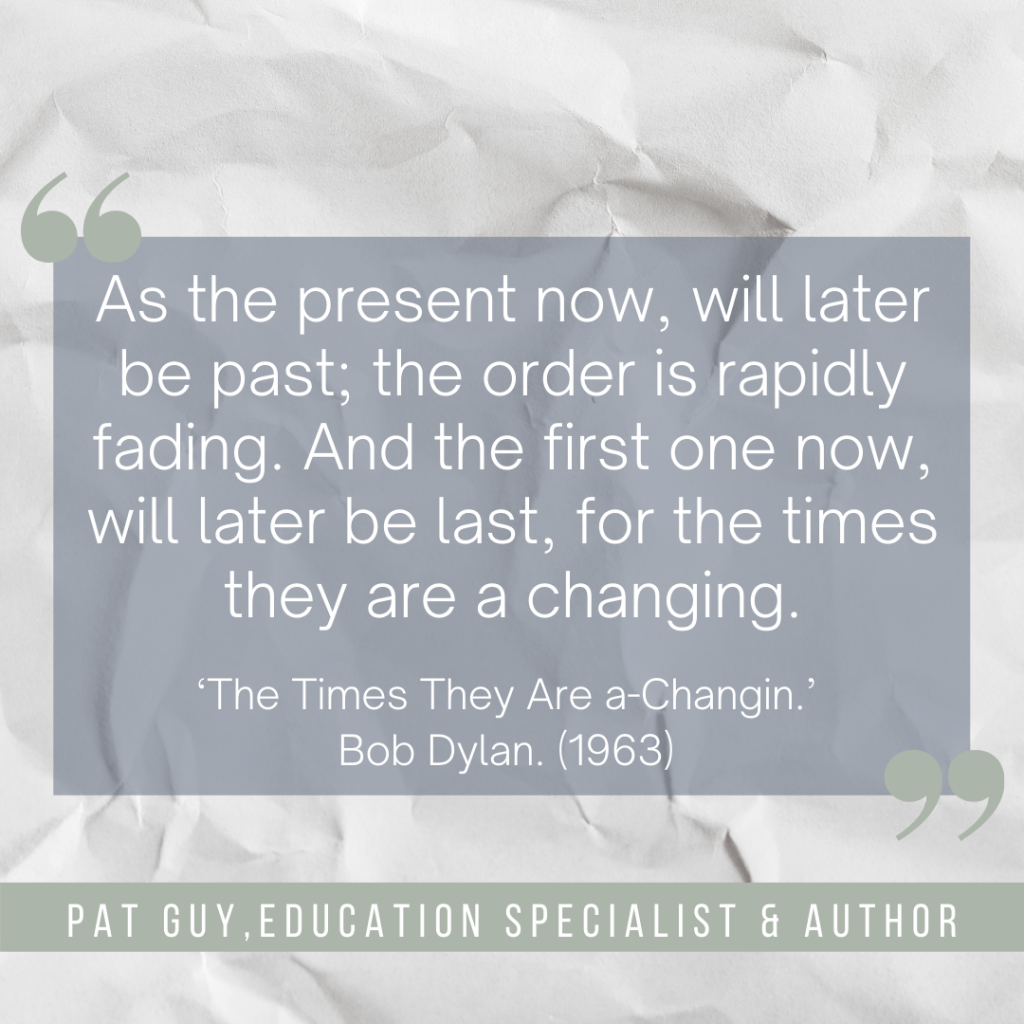
‘As the present now, will later be past; the order is rapidly fading. And the first one now, will later be last, for the times they are a changing.’

‘The Times They Are (Always) a-Changin.’ Bob Dylan. (1963)

Our Parents

‘Don’t it always seem to go that you don’t know what you’ve got till it’s gone.’ Big Yellow Taxi. Joni Mitchell.

It’s always interesting to read the articles in Big Issue from well-known figures about advice they would give their sixteen-year-old selves, (Letter To My Younger Self).

Each individual has a different story to tell. Some of the personalities had a privileged upbringing, others grew up in large, happy families or as a precious only child, while others had more challenging home circumstances. Every individual brings their life experience to the advice they would give their younger selves: not to worry about the opinions of others, to appreciate that life isn’t like school, to be more patient with themselves, to be braver, and so on. 

However, when talking about their childhood, there seems to be one reoccurring theme. All of the personalities expressed regret about their communication, or lack of, with their parents: –

  • ‘If I could go back now, I’d be kinder to my parents.’ John Lydon. Musician.
  • ‘My mum and dad have passed away, but I talk to them every day. I don’t know if they’re hearing me, but I need to talk to them.’ Billie Jean King. Tennis player.
  • ‘I’d love to go back and spend a day with my mum and dad and tell them how much I love them.’ Tom Jones. Musician.
  • ‘I’d tell my younger self that he could and should learn more from his parents.’ Sir Roger Bannister. Athlete.
  • ‘I’d tell my younger self to be more respectful of my parents.’ Chrissie Hynde. Musician.
  • ‘Perhaps I could have said things to my mother or father that would have made their lives easier.’ Grayson Perry. Artist.
  • ‘Even now, when people complain about how they are burdened with their mums and dads, I recoil. I often wish I had parents to tell me what a muck-up I’ve made in my life.’ Lord Bird. Co-founder of the Big Issue.

Perhaps it is only as we grow into our adult roles that we truly understand and appreciate our parents: –

  • ‘My mother was the heart of the family and influenced me more than I knew.’ Mary Robinson. Former President of Ireland.
  • ‘I think I wish I’d asked my father that, I wish I’d written that down, I wish I’d taped that conversation.’ Neil Gaiman. Author.
  • ‘If I could, I’d have tried to spend more time with my dad.’  Barry McGuigan. Boxer. 
  • ‘I’m not sure I even realised how amazing my dad was – but if I was 16 again, I’d tell him.’ David Cameron. Politician.
  • ‘If I could go back in time, I’d have a long, last conversation with my mum.’ Baroness Shami Chakrabarti. Politician and Lawyer. 
  • ‘I’d have liked to have more time to get to know my father.’ Philip Glass. Composer. 

Maybe we should learn from the regrets of others and be more appreciative of our immediate family while we have time. As Joni Mitchell sang: ‘Don’t it always seem to go that you don’t know what you’ve got till it’s gone.’

Promoting Sport in Schools

Sport will develop all of the attributes necessary for an individual’s mental and physical well-being, and yet the benefits of physical exercise in schools are often overlooked, and Games and Sport side-lined as an optional extra in the curriculum. 

The development of sport within schools does not require government appointed Sports Tsars, sporting role models attending Speech Days, or the use of independent schools’ playing fields during holidays. The true integration of sport into children’s lives is about giving all children from nursery through to sixth-form the chance to exercise on a daily basis. When opportunities for PE, Dance, Games and Sport are part of every school day, all children can take pleasure in physical activity from an early age and grow up seeing exercise as part of everyday life.

Activities do not need to be challenging, complicated or linked to specialist programs. Physical activity in childhood is a natural state of affairs. When children and young people see it is normal to cycle or walk to school, climb trees, go swimming, walk the dog, bike to the shops, play active games in the school playground and roller skate or skateboard in the park, they are more likely to incorporate exercise into their daily routine and less likely to be at risk from obesity, diabetes and poor general health. 

The more children and young people participate in sport, the more confident they will become in their ability, increasing the likelihood of further activity, which will improve their skill level and further reinforce motivation.

Activities that could be organised easily in schools would include: –

  1. Liaising with other schools to share sport taster days, specialist facilities and resources. 
  2. Sharing input from enthusiasts within schools. Asking parents and grandparents to introduce and demonstrate the sports they particularly enjoy. 
  3. Showing videos of different kinds of sports, for example: martial arts, skate boarding, speed climbing, synchronised swimming, cyclo-cross and parkour.
  4. Organising visits to, and social events at, sporting venues: bowling alleys, go-kart tracks, ski domes, equestrian centres, archery and golf ranges, climbing centres or ice-skating rinks. 
  5. Establishing a loan system that enables pupils to borrow equipment from school, or selling off any old, but still usable, PE Department stock to boost school funds.
  6. Providing opportunities to try out different kinds of dance: disco, tap, street dance, salsa, dance mats, country dancing, swing, line dancing or hip hop.
  7. Promoting a variety of indoor games: 5 a side hockey, Football Rounders, French Cricket, Table Tennis, Korfball and Walking Netball.
  8. Setting up orienteering courses around the school grounds.
  9. Using of a variety of equipment during playtimes to practise basic skills: Velcro mitten and ball sets, juggling balls, boom bats, badminton sets, stilts or foot pots. Hopscotch grids, hoopla, skittles and hoops. Frisbee throwing and catching games. Boules. Skipping and French skipping to teach the children simple and more complex skipping games.
  10. Encouraging lunch time supervisors to organise physically active games: Hide and Seek, Chase, It, Grandma’s Footsteps, Piggy in the Middle, What’s the time, Mr Wolf, Mr Crocodile and Follow the Leader.
  11. Setting up circuits in the playground: ten star jumps, twenty skips, five runs across the playground and ten press ups.
  12. Teaching young children traditional songs and games that involve physical movement: Oranges and Lemons, Simon Says, The Farmer’s in his Den, I sent a Letter to my Love, Heads, Shoulders, Knees and Toes, and In and Out the Dusty Bluebells.

The long-term physical and mental benefits of sport are well documented. Exercise promotes fitness and fights off obesity, sharpens memory, boosts concentration, improves cognitive function and releases endorphins to ward off stress, anxiety and depression.

My Grandson Shows off his Illustration Skills…

My wonderful grandson, Jamie, has been featured on his school’s social media pages – showing off his published illustrations which feature in my books ‘Olivia and the Proverbs’ and ‘Olivia and the Proverbs 2’. I have always found children’s artwork and illustration to be absolutely joyful – it was my pleasure to include his enchanting drawings in my books. They are so special to me, and I’m thrilled he is getting such lovely recognition from his school.

It was my pleasure to donate copies of both books to his school library.

The Instagram post reads:

@bedfordmodern Year 5 student Jamie has had two of his illustrations feature in children’s books recently written and published by his grandmother, Pat Guy. The stories focus on Olivia Monkey, who has adventures and learns lessons based around different proverbial sayings. Copies have been kindly donated to the Junior School library and Jamie has been very excited to share them with his friends.

#books #bookstagram #newbook#stories #bedfordmodernschool#bedford #bedfordshire#bedfordschools #education#schools #school #students#learning #bedfordindependent

Learned Helplessness

‘Learned helplessness’ describes the sense of powerlessness felt by some individuals when they are presented with a problem or challenge. They will not act to help themselves because they believe that there is nothing they can do: the situation is hopeless. 

Some individuals develop learned helplessness as a result of repeated negative life experience. Others will develop learned helplessness as a result of mimicking the behaviour of their close contacts: parents, extended family, friends and peers: – 

  • Their family will talk about everyone else being luckier and more fortunate than them.
  • Their parents may believe that other people face challenges in life, but the challenges that they experience are exceptional.
  • Their friends will spend more time discussing their problems, than exploring possible solutions.

How can we avoid passing learned helplessness on to children?

  1. Encourage the child to take responsibility. If they put the blame on others, they won’t have the opportunity to improve. 

Child: ‘The Chemistry teacher didn’t explain the test properly, so I didn’t know what to revise.’

Adult: ‘Maybe next time, you could ask her to explain what the test is about. I bet the whole class would be grateful for that.’

  1. Express confidence in the child’s ability to deal with challenges and to handle tricky situations. Give them time to have a moan, then move them on to consider what their options are. 
  2. Focus on taking the positives from a situation. Practise looking for silver linings.

Adult: ‘OK, so Alex was selected as goalie for this game, but the other team’s strikers were county players, and scored twenty goals. I expect now, Alex really wishes you’d been chosen instead!’

  1. Set an example. Don’t be seen to brood over difficulties, be seen to take action.
  2. Acknowledge that life is difficult sometimes, but that there are always other people who are worse off. 
  3. Children need to be taught to be pro-active: to speak up and explain what is wrong, to ask for help, rather than sulk, get upset or withdraw.
  4. Allow children generous amounts of time for free play to give them practice in sorting out disagreements by themselves.
  5. Allow choices to show that there is always something you can control. 

Adult: ‘Which T-shirt would you like to wear today?’ ‘Do you want peas or sweetcorn with your fish fingers?’ ‘Are you going to do that homework before or after tea?’

  1. Help the child to look at the facts of a situation, rather than focus on how they feel.

Adult: ‘Did Jacob really shout at you because he hates you and doesn’t want to be friends anymore, or might it have been because you kicked his ball over the fence? If you go next door when Mrs Smith gets home, I’m sure she’ll let you get it back for him.’

  1. Be aware of what you say. Repeatedly recounting how unhappy you were at secondary school because you were teased by other children or had strict teachers, may make the child expect to be bullied or to be wary of teaching staff.

Politics and Hubris

The dictionary definition of hubris is- a personality trait of extreme or foolish pride, dangerous overconfidence, often in combination with arrogance.’  

There are many examples of ‘hubrists’ in the world of politics. Charisma, charm, the ability to inspire and persuade, enjoying risk taking and possessing bold self-confidence are all qualities associated with successful leadership. It would be hard to face the continual criticism, back stabbing and media scrutiny of modern politics without having a strong sense of entitlement. Unfortunately, the hubristic leader may also believe that their performance and knowledge are far superior to that of others, and their success is guaranteed simply because they are always right. They will make reckless decisions, ignore the advice of others, and genuinely believe that they deserve to be above the law. This discrepancy between a leader’s high level of self-confidence and their less than perfect decision making can have devastating repercussions, for example, Bush and Blair’s confidence in the period leading up to the 2003 Iraq War, contrasting with their abject failure to anticipate the far-reaching consequences of the war. 

While the effects of national and international leaders’ hubris are obvious to all, hubris can also be observed in businesses and organisations across all levels. 

In order to avoid falling into the hubris trap individuals need to:

  • Reflect on past situations where hubris has caused problems and acknowledge the dangers of over confidence and arrogance.
  • Reflect on their own performance honestly: recognising failures, taking responsibility for things that went wrong and, when thinking about successes, always acknowledging the contribution of others.
  • Not take themselves too seriously; be willing to make mistakes and appear less than perfect. 
  • Surround themselves with people who will help to ground them in reality, rather than ‘yes men’ who will boost their ego. 
  • Ask others for their opinion and listen to what they say.
  • Pay attention when given feedback, and think about what is being said.
  • Be kind. When making decisions, think about how the decisions made will affect others.

Olivia and the Proverbs 2 is here!

IT’S HERE!!

OLIVIA AND THE PROVERBS 2 is now available to buy on Amazon.

About the book:

Olivia Monkey lives with her family and pet dog, Biscuit, in a house near the middle of town. The big house next door is a retirement home for elderly monkeys. Olivia has lots of friends at the retirement home, but her two very best friends are Boris Monkey and Blossom Monkey.

This book consists of twelve stories about Olivia’s adventures with Boris and Blossom.Each story is based around a proverb. For example, ‘Nothing ventured, nothing gained’ or ‘A problem shared is a problem halved.’ At the end of each story the reader will have learnt something about what is really important in life.

Olivia’s adventures are based on stories that my daughter and I made up about her favourite soft toys – all monkeys!

The beautiful illustrations are once again by the amazing Alessandra Covino.

Shop here: https://www.amazon.co.uk/OLIVIA-PROVERBS-2-Pat-Guy-ebook/dp/B09KP2M6ML/ref=tmm_kin_swatch_0?_encoding=UTF8&qid=1635772550&sr=1-2

Thank you once again for your support!

Pat Guy

Developing Children’s Emotional Intelligence.

Children who do well in school, do not always succeed in life: some may be academically brilliant, but find that their weaker emotional and social skills limit their achievement. 

Emotionally intelligent individuals: –

  1. Are self-aware. They understand their emotions, and why they react to situations in the way they do. 

To help your child become more self-aware: –

  • Help them to identify and label their emotions: ‘I’m feeling irritated because football practice has been cancelled. I really wanted to go tonight.’ ‘I’m worried because we’ve got a Physics test tomorrow and I don’t understand the topic.’ 
  • Allow them to express their feelings without fear of judgement, and then listen to what they say.
  • Help the child to develop the ability to communicate their feelings and opinions clearly and calmly to others.
  1. Are able to self-regulate.  Emotionally intelligent individuals are able to manage their behaviour; for example, they can remain calm when angry, or use relaxation techniques when nervous. 

To help your child to self-regulate: –

  • Demonstrate how to pause and use your head, before reacting to a situation. If the adult is able to respond calmly during periods of stress, children will learn how to remain calm. If the adult stops to consider choices, the child will learn to do the same. 
  • Demonstrate a variety of ways to cope with negative feelings: go for a walk in the fresh air, run up and down the stairs, clean your bedroom, listen to music or distract yourself by spending some time on a favourite hobby.
  • Children learn by copying the behaviour of those close to them, so try to demonstrate positive thinking by, for example, recognising that a challenge or problem exists, and trying to find a solution rather than appearing helpless.
  • Be brave: help your child to understand that mistakes and failures are part of life, but with practice and perseverance, they will be able to progress. 
  • Humour, laughter and play are perfect antidotes for negative feelings. Laughter reduces stress and will calm the child down.
  1. Have the ability to understand the feelings of others. Empathetic children are considerate. Everyone enjoys their company and feels better after spending time with them.

To help your child to develop empathy: –

  • Be empathetic yourself, so the child sees kind, thoughtful behaviour as the norm. Being kind releases hormones that will improve the individual’s physical and mental health.
  • Explain that there are always two sides to every story. If a friend is arguing, they could be feeling tired, worried or sad. 

‘How might Theo have felt when you teased him? How would you have felt if he did that to you?’ 

  • If the child hurts a friend’s feelings, teach them how to apologise. 
  • Show the child how to be a good listener: to listen attentively without looking away, fidgeting or showing boredom through body language. To ask open ended questions that require more than a yes / no response, and to make supportive responses: I see, uh-huh, mmm, OK.
  1. Possess good social skills. Children with good social skills are popular with their peers. They will sort out friend’s arguments, maintain old friendships and forge new ones.

To help your child to develop their social skills: –

  • Allow the child plenty of time for free play. Through free play, children practise empathy, develop self-awareness and self-expression, acquire conflict resolution skills, the ability to take turns, co-operate with others, and the skills required to self-regulate.